All lessons Module 8: Clinical practice Lesson 7
Anxiety, low mood and the spirits
When is low mood or anxiety a pattern to treat and when a reason to refer today, and which spirit is affected?
After this lesson you can ask about suicidal thoughts and know what to do next, you know the medical causes of anxiety and low mood, you can link emotion, Qi movement and spirit, recognise eight patterns from agitated to unanchored, and you know what the research does and does not show. This material lies outside the Foundations: textbook knowledge, with PubMed.
With low mood or anxiety, always ask about suicidal thoughts.
Know by heart
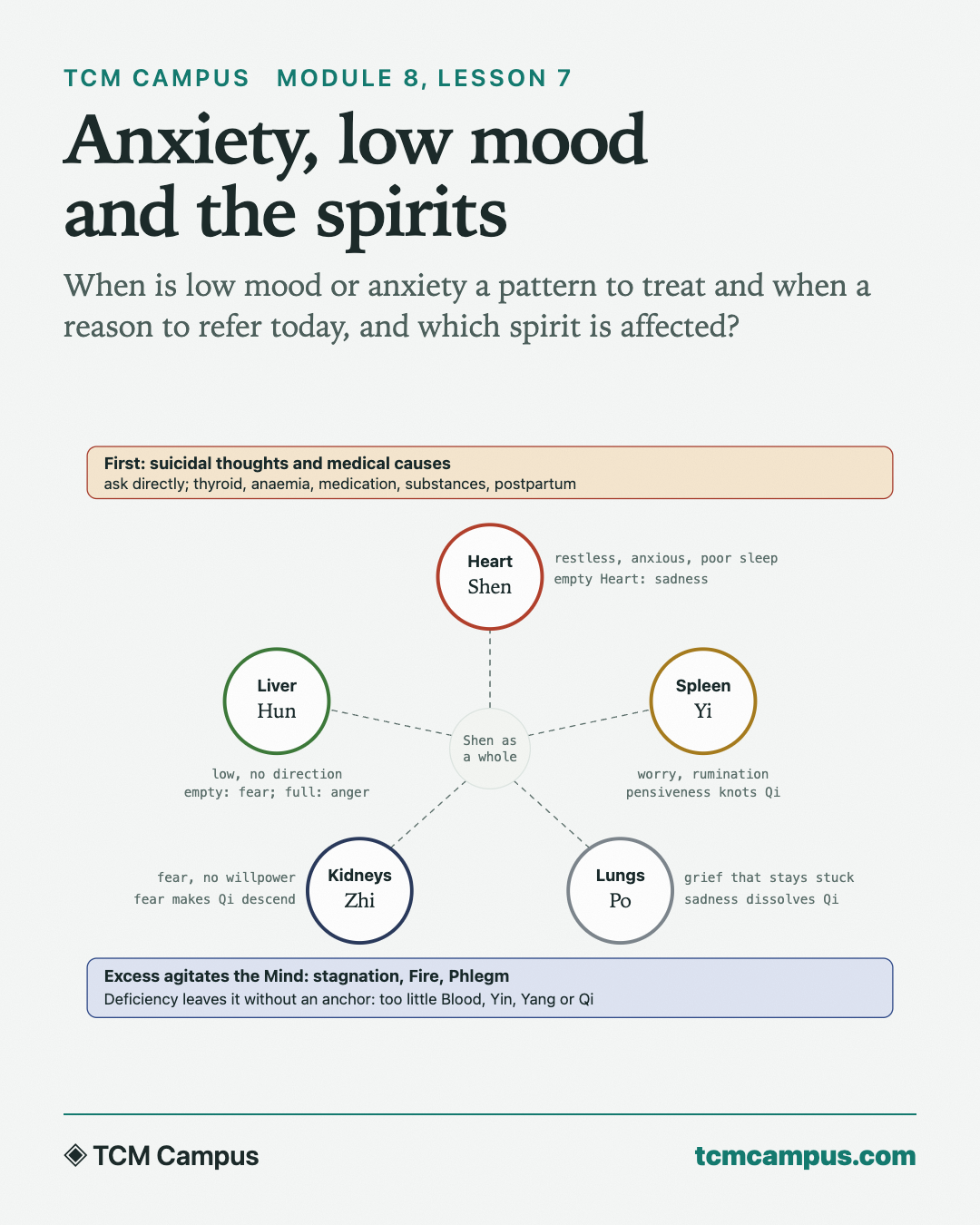
- Suicidal thoughts first. Ask directly; asking does not raise the risk. A plan, the means or saying goodbye: do not leave the person alone; the same day a GP or out-of-hours service, in immediate danger emergency services (112 in Europe, 999 in the UK, 911 in North America); always pass on: contact your local crisis line or emergency services (for example 988 in the US, 116 123 Samaritans in the UK and Ireland, 13 11 14 Lifeline in Australia). mnemonic: ask, stay, hand over.
- Medical first. Thyroid (overactive: anxiety and palpitations; underactive: low mood), anaemia and B12, medication and substances, an arrhythmia behind panic, postpartum, new after 60. Never advise stopping psychiatric medication.
- Su Wen 39. Anger makes the Qi rise, joy slows it down, sadness dissolves it, fear makes it descend, shock scatters it, pensiveness knots it. mnemonic: rise, slow, melt, drop, scatter, knot.
- Ling Shu 8. An empty Liver gives fear, a full Liver anger; an empty Heart gives sadness. Shen restlessness and sleep, Hun direction, Yi worrying, Po grief and breath, Zhi will and fear.
- Agitated or unanchored. Excess: Liver-Qi stagnation (sighing, wiry), Liver-Fire (anger, yellow coating), Phlegm-Qi (lump in the throat), Phlegm-Heat (anxiety, sticky yellow coating). Deficiency: Heart-Blood with Spleen (worrying, pale), Heart and Kidneys (restless at night), Heart and Gall-Bladder (easily startled), Kidney-Yang (no will). mnemonic: the coating says Phlegm, the tip says Heart, the sides say Liver.
- Formulas (textbook knowledge). Chai Hu Shu Gan San, Bupleurum Soothing the Liver Powder, or Xiao Yao San, Free and Easy Wanderer; Long Dan Xie Gan Tang, Gentiana Draining the Liver Decoction; Ban Xia Hou Po Tang, Pinellia and Magnolia Bark Decoction; Wen Dan Tang, Warming the Gall-Bladder Decoction; Gui Pi Tang, Restoring the Spleen Decoction; Tian Wang Bu Xin Dan, Heavenly Emperor Tonifying the Heart Pill; An Shen Ding Zhi Wan, Calming the Mind and Settling the Will Pill; Gan Mai Da Zao Tang, Liquorice, Wheat and Jujube Decoction. Cinnabar (Zhu Sha) is mercury.
- Evidence. Depression: fewer symptoms against a waiting list or usual care, small and uncertain against sham (class III); in primary care, acupuncture and counselling both helped more than usual care. Anxiety before surgery: better than sham (II). Anxiety disorders: too little research (O).
The rest of this lesson is reference.
Three practice questions from this lesson
Case. Man, 52, low since the death of his wife. He says he no longer sees the point and that he has been saving up pills. What do you do?
- Stay with him; the GP or out-of-hours service the same day
- Ask him to think it over and phone you again tomorrow morning
- Nourish Heart-Blood and calm the Shen; continue next week
Answer: Stay with him; the GP or out-of-hours service the same day. A plan with means is acute danger. Not a pattern, but action: do not leave him alone, hand over the same day to the GP or out-of-hours service (who bring in the crisis team), in immediate danger emergency services (112 in Europe, 999 in the UK, 911 in North America), and give him the local crisis line. Tomorrow or next week is too late.
Does asking about suicidal thoughts increase the likelihood of them?
- Yes; so you only ask indirectly
- Yes; so you wait until they raise it
- No; if anything it seems to reduce them
Answer: No; if anything it seems to reduce them. No: in the studies examined it did not increase, and talking about it seems, if anything, to reduce it (Dazzi 2014). Asking directly is the standard, not indirectly or waiting: 'Do you ever think about ending your life?'
Case. Woman, 29, three weeks after giving birth: does not sleep, even when the baby sleeps, is confused and says the baby is not hers. What first?
- Rest, and the GP or primary care doctor within a week
- The GP or out-of-hours service the same day
- Gui Pi Tang for the Blood first, then wait
Answer: The GP or out-of-hours service the same day. Confusion and delusions after giving birth are a psychiatric emergency: think of postpartum psychosis, the same day. A week is too long. In TCM language you may think of Blood deficiency later, but not now.
The rest of this lesson
In the course you get the step-by-step explanation, 15 case-based practice questions, 17 spaced-repetition flashcards, the pitfalls and the bridge to physiology with evidence grades. This lesson belongs to module 8: Clinical practice.