All lessons Module 6: Points Lesson 13
Bladder 1: from the eye to the sacrum, and the Back-Shu points
Why does an acupuncturist choose a point on the back for an organ, and how do they know which point belongs to which organ?
After this lesson you can name the Back-Shu points in order with their organ, place the five spirits on the outer Bladder line, know the points of the head and upper back by name and category, and explain when a back point helps in diagnosis.
Know by heart
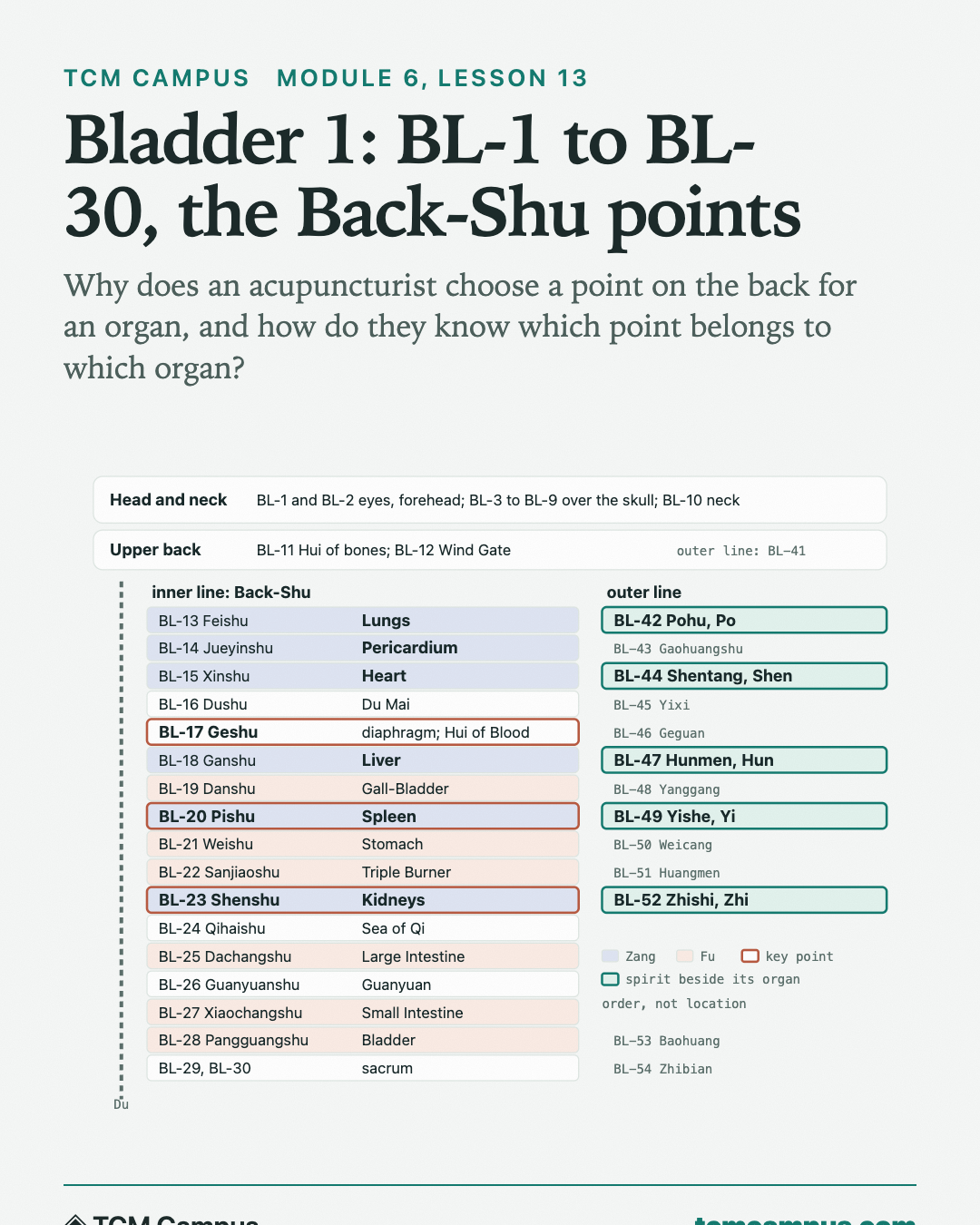
- Back-Shu in order. BL-13 Lungs, BL-14 Pericardium, BL-15 Heart, BL-16 Du, BL-17 diaphragm, BL-18 Liver, BL-19 Gall-Bladder, BL-20 Spleen, BL-21 Stomach, BL-22 Triple Burner (San Jiao), BL-23 Kidneys, BL-25 Large Intestine, BL-27 Small Intestine, BL-28 Bladder. mnemonic: as they lie in the trunk: chest, diaphragm, upper abdomen in pairs (Liver with Gall-Bladder, Spleen with Stomach), then Triple Burner, Kidneys, intestines, Bladder.
- Five spirits on the outer line. BL-42 Pohu (Po, Lungs), BL-44 Shentang (Shen, Heart), BL-47 Hunmen (Hun, Liver), BL-49 Yishe (Yi, Spleen), BL-52 Zhishi (Zhi, Kidneys). mnemonic: Back-Shu plus 29: 13, 15, 18, 20, 23 become 42, 44, 47, 49, 52.
- Three key points. BL-17 Geshu: Back-Shu of the diaphragm; Hui of Blood; nourish and move Blood. BL-20 Pishu: Back-Shu of the Spleen; tonify the Spleen, Dampness. BL-23 Shenshu: Back-Shu of the Kidneys; tonify the Kidneys, lower back.
- What a Back-Shu point does. A back point per organ; mainly for chronic Deficiency; becomes tender with a problem of its organ and so helps in diagnosis. mnemonic: the back is chronic and empty, the front is acute and full.
- Head and upper back. BL-1 Jingming: eyes. BL-2 Zanzhu: forehead and eyes. BL-10 Tianzhu: back of the head and neck; Window of Heaven. BL-11 Dazhu: Hui of the bones; Sea of Blood. BL-12 Fengmen: Wind Gate, the Exterior.
- Limits. Back-Shu points over the rib cage lie above the lung: pneumothorax with depth. BL-1 lies by the eye. Lumbosacral area: pregnancy.
The rest of this lesson is reference.
Three practice questions from this lesson
Which organ belongs to BL-18 Ganshu?
- Liver
- Gall-Bladder
- Spleen
- Heart
Answer: Liver. Gan is the Liver. BL-19 Danshu is the Gall-Bladder, BL-20 Pishu the Spleen, BL-15 Xinshu the Heart.
What is the correct order from top to bottom?
- Lungs, Pericardium, Heart
- Heart, Lungs, Pericardium
- Pericardium, Heart, Lungs
Answer: Lungs, Pericardium, Heart. BL-13 Lungs, BL-14 Pericardium, BL-15 Heart.
Which point is the Back-Shu of the diaphragm and also the Hui of Blood?
- BL-11 Dazhu
- BL-17 Geshu
- BL-23 Shenshu
Answer: BL-17 Geshu. BL-17 Geshu. BL-11 is the Hui of the bones, BL-23 the Back-Shu of the Kidneys.
The rest of this lesson
In the course you get the step-by-step explanation, 16 case-based practice questions, 20 spaced-repetition flashcards, the pitfalls and the bridge to physiology with evidence grades. This lesson belongs to module 6: Points.