All lessons Module 1: Foundations Lesson 20
Six cases, from finding to evidence
Which three findings separate two patterns that look alike, and what can you honestly promise after that?
Six cases, each in ten fixed steps from red flag to evidence. No book pages: the source is the case itself. You choose first; the explanation comes after your choice.
Know by heart
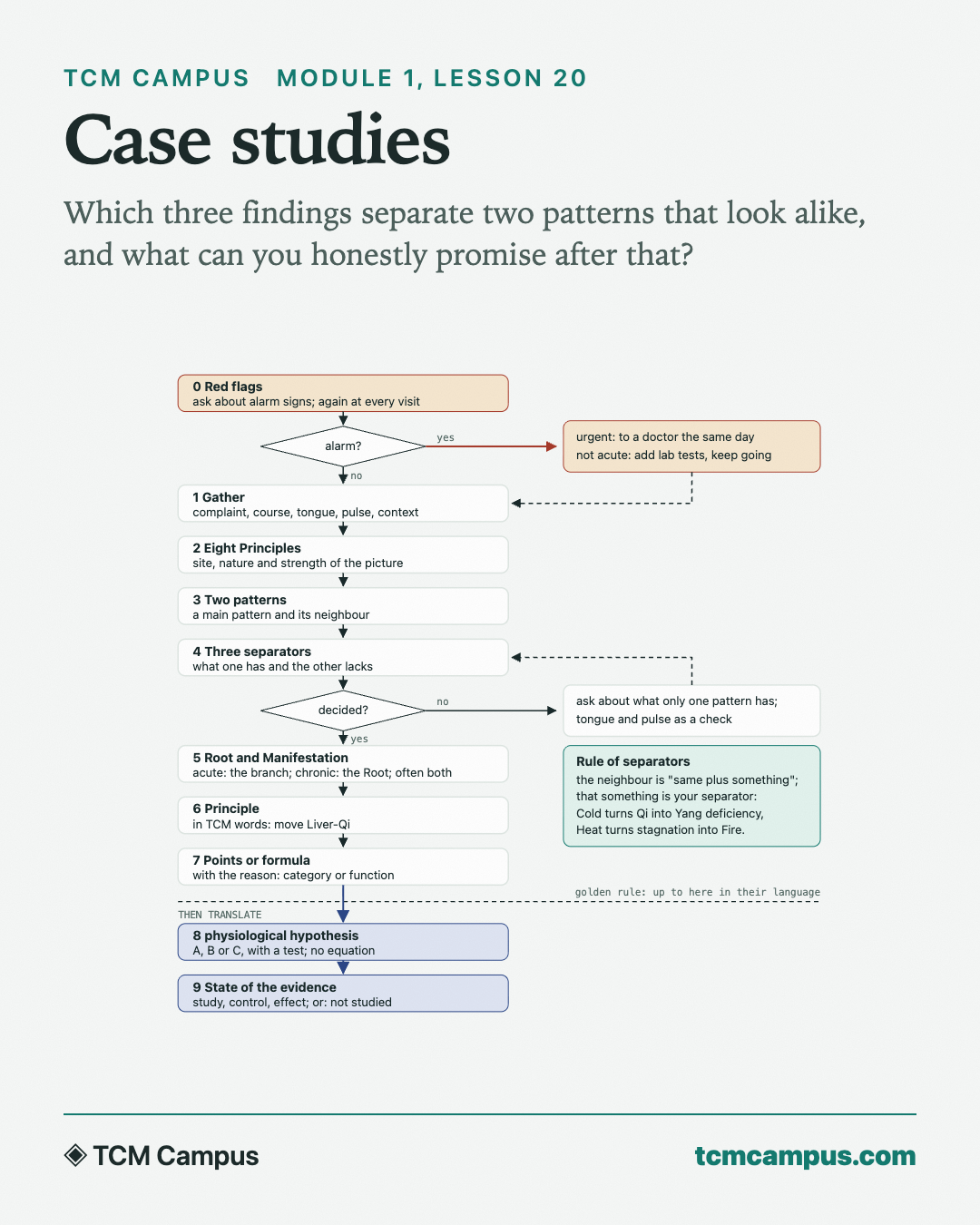
- The ten steps. 0 red flags; 1 gather; 2 Eight Principles; 3 two patterns; 4 three separators; 5 Root and Manifestation; 6 principle; 7 points or formula; line; 8 physiological hypothesis (A, B or C, with a test); 9 state of the evidence; mnemonic: flag first; then "Gather Eight Patterns, Separate Root, Principle, Point"; only then translate.
- Signs with two readings. night sweating, night pain, tired with loose stools, morning nausea, headache with red eyes, yellowing, breathlessness, palpitations: medical first, then TCM.
- The six differentials. 1 Spleen-Qi versus Spleen-Yang; 2 Liver-Qi stagnation versus Liver-Fire; 3 Kidney-Yin, Heart and Kidneys, Heart-Blood; 4 Blood stasis, Cold-Damp Bi, Kidney deficiency; 5 Damp-Heat, Damp-Phlegm, retention of food; 6 Liver invading the Spleen, with Heart-Blood deficiency.
- The rule of separators. the neighbour is "the same plus something", and that something is your separator: Cold turns Qi deficiency into Yang deficiency; Heat turns stagnation into Fire and Dampness into Damp-Heat; the Heart turns Kidney-Yin deficiency into Heart and Kidneys not harmonised; mnemonic: what is added separates; what they share does not.
- Empty- versus Full-Heat. empty: Yin hours, small sips, hot soles, little coating, thin-rapid; full: intense, thirst, thick yellow coating, full rapid pulse (lesson 2).
- Root and Manifestation, and how patterns move. acute: the Manifestation first; chronic: the Root; often both; Qi deficiency becomes Yang deficiency, stagnation becomes Fire, Spleen-Qi deficiency leads to Blood deficiency leads to Heart-Blood deficiency, Liver-Qi stagnation leads to Liver invading the Spleen.
- Three lessons on study design. Cherkin 2009: individualised, fixed and simulated equally good in back pain; Hogeboom 2001: six acupuncturists, twenty diagnoses for six patients; Dai 2024: per protocol is not intention-to-treat; mnemonic: those who keep taking it differ from those who stop.
The rest of this lesson is reference.
Three practice questions from this lesson
Red flag. She has no alarm sign, but no blood tests either. What do you do?
- Start, and meanwhile have iron, thyroid and coeliac disease tested
- Have everything investigated first and do nothing until the results
- Start without tests; without an alarm sign blood tests are superfluous
Answer: Start, and meanwhile have iron, thyroid and coeliac disease tested. Work out the pattern and at the same time arrange Hb, ferritin, TSH and coeliac serology. Without an alarm sign you need not wait, but iron deficiency, coeliac disease and thyroid problems give exactly this picture; that is why you test them in any unexplained tiredness. A normal result does not make your TCM analysis superfluous; an abnormal one changes your whole plan.
Eight Principles. How do you label the picture as it stands?
- Exterior, Excess, Wind-Cold
- Interior, Deficiency, nature still open
- Interior, Excess, Heat together with Dampness
Answer: Interior, Deficiency, nature still open. Chronic, no acute Exterior picture: Interior. Tired, soft voice, empty pulse: Deficiency, no pathogen fighting back (lesson 2). Heat or Cold you do not know yet: she says nothing about it, and a pale tongue with a thin white coating gives no Heat. That open box is the core of this case.
Two patterns. Which do you set side by side?
- Liver-Qi stagnation and Liver invading the Spleen
- Spleen-Qi deficiency and Spleen-Yang deficiency
- Spleen-Qi deficiency and Damp-Heat
Answer: Spleen-Qi deficiency and Spleen-Yang deficiency. Tired, poor appetite, bloated after eating, loose stools, weak limbs, pale tongue with teeth marks, empty pulse: pattern 6, almost word for word. Pattern 7 is 'like 6, plus cold'. No link with stress and no wiry pulse: not the Liver. No red tongue or yellow coating: not Damp-Heat.
The rest of this lesson
In the course you get the step-by-step explanation, 53 case-based practice questions, 17 spaced-repetition flashcards, the pitfalls and the bridge to physiology with evidence grades. This lesson belongs to module 1: Foundations.