All lessons Module 6: Points Lesson 5
Chong Mai and Dai Mai
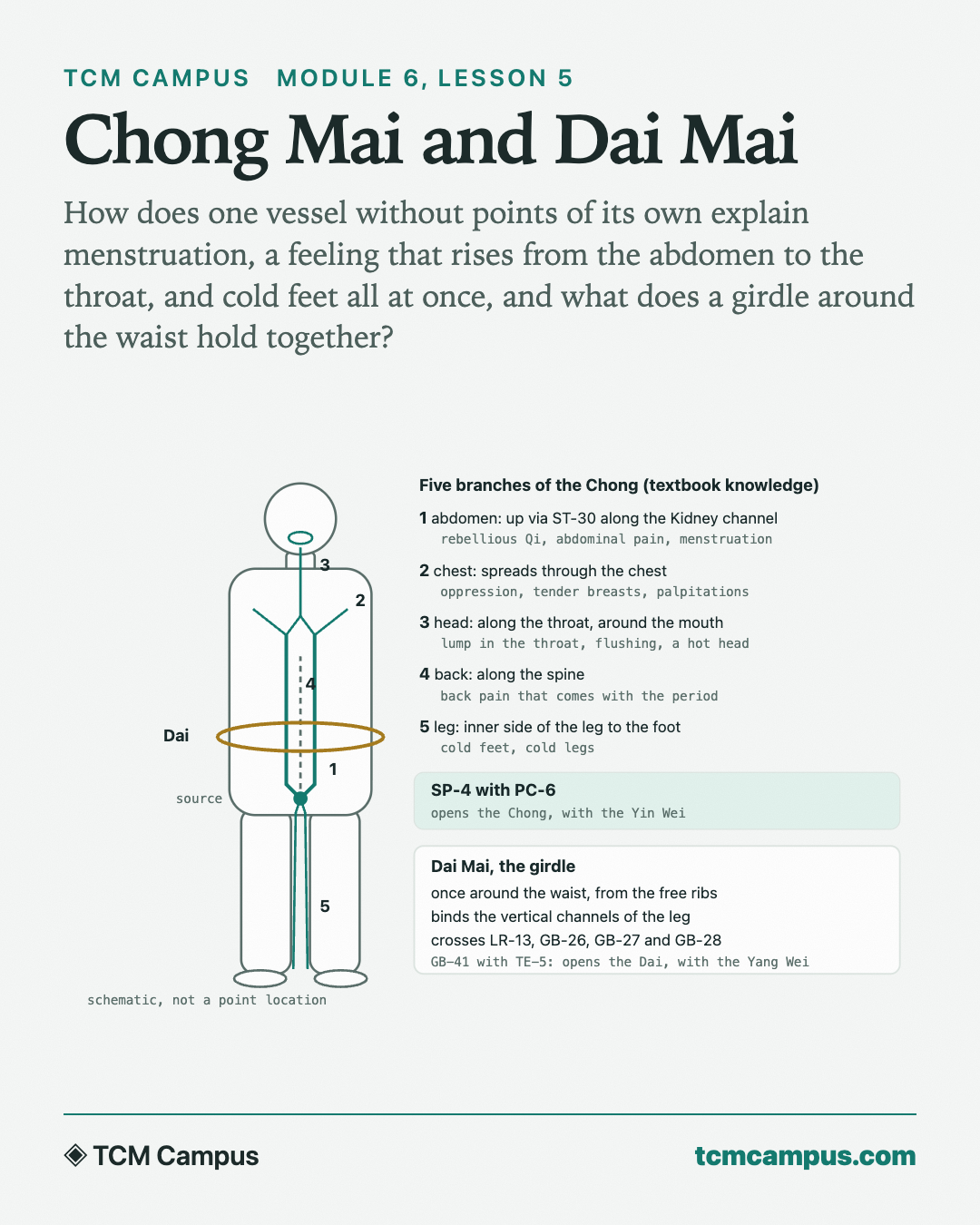
How does one vessel without points of its own explain menstruation, a feeling that rises from the abdomen to the throat, and cold feet all at once, and what does a girdle around the waist hold together?
After this lesson you know the functions of the Chong, its branches, its opening pair and its crossing points, you recognise the picture of rebellious Qi, you know the girdle of the Dai with its points and its two sides, too tight and too slack, and you know when a practitioner chooses one vessel or the other.
Know by heart
- Chong Mai. Sea of Blood, Sea of the twelve channels, Sea of the five Zang and six Fu; no points of its own. Opening point SP-4, coupled point PC-6 (Yin Wei). mnemonic: the Chong charges, from the belly to the heart.
- Five branches. Abdomen (via ST-30 along the Kidney channel), chest, head (throat, around the mouth), back (along the spine), leg (inner side, to the foot). mnemonic: belly, chest, head, then back and leg.
- Points of the Chong. Crossing points CV-1, ST-30 and KI-11 to KI-21; as the Sea of Blood BL-11 above and ST-37 and ST-39 below (Ling Shu 33).
- Rebellious Qi of the Chong. Nan Jing 29: Qi rebelling upwards, with cramp in the abdomen. From the lower abdomen via the stomach and chest to the throat and face: fullness, oppression, palpitations, a lump in the throat, flushing, restlessness; and cold feet. mnemonic: hot and full above, cold below.
- Dai Mai. The only horizontal vessel: once around the waist from the free ribs; binds the vertical channels. Crosses LR-13, GB-26, GB-27 and GB-28. Opening point GB-41, coupled point TE-5 (Yang Wei). mnemonic: dai xia, below the girdle, is the Chinese word for discharge.
- The Dai, too tight or too slack. Nan Jing 29: full abdomen, a waist as if sitting in water. Too tight: stagnation and Damp-Heat, pain in the hips and flanks, yellow discharge. Too slack: weak legs (Su Wen 44), prolapse, chronic white discharge.
- Red flags. Chest pain on exertion; a lump in the breast; difficulty swallowing or weight loss with a lump in the throat; discharge with fever, blood or abdominal pain; a new mass in the lower abdomen: see a doctor first.
The rest of this lesson is reference.
Three practice questions from this lesson
Which point opens the Chong Mai?
- KI-6
- SP-4
- PC-6
Answer: SP-4. SP-4 opens the Chong; PC-6 is the coupled point and opens the Yin Wei.
Which vessel does GB-41 open?
- Dai Mai
- Chong Mai
- Yang Wei
Answer: Dai Mai. GB-41 opens the Dai; the coupled point TE-5 opens the Yang Wei. Both Shaoyang.
Which points does the Dai cross?
- CV-1 and GV-1
- LR-13, GB-26, GB-27 and GB-28
- CV-1, ST-30 and KI-11 to KI-21
Answer: LR-13, GB-26, GB-27 and GB-28. From the free ribs (LR-13) around the waist via GB-26 to GB-28. CV-1, ST-30 and KI-11 to KI-21 are crossing points of the Chong.
The rest of this lesson
In the course you get the step-by-step explanation, 15 case-based practice questions, 20 spaced-repetition flashcards, the pitfalls and the bridge to physiology with evidence grades. This lesson belongs to module 6: Points.