All lessons Module 3: Causes Lesson 2
Climate and invasion
Why does one person fall ill from a cold wind and another does not, and what happens to the invader afterwards?
After this lesson you know when climate causes disease, you read a climate name as a pattern and not as a weather report, you know the six pathogens by their behaviour, you can tell Wind-Cold from Wind-Heat by chills and fever, and you know the three outcomes of an invasion.
Know by heart
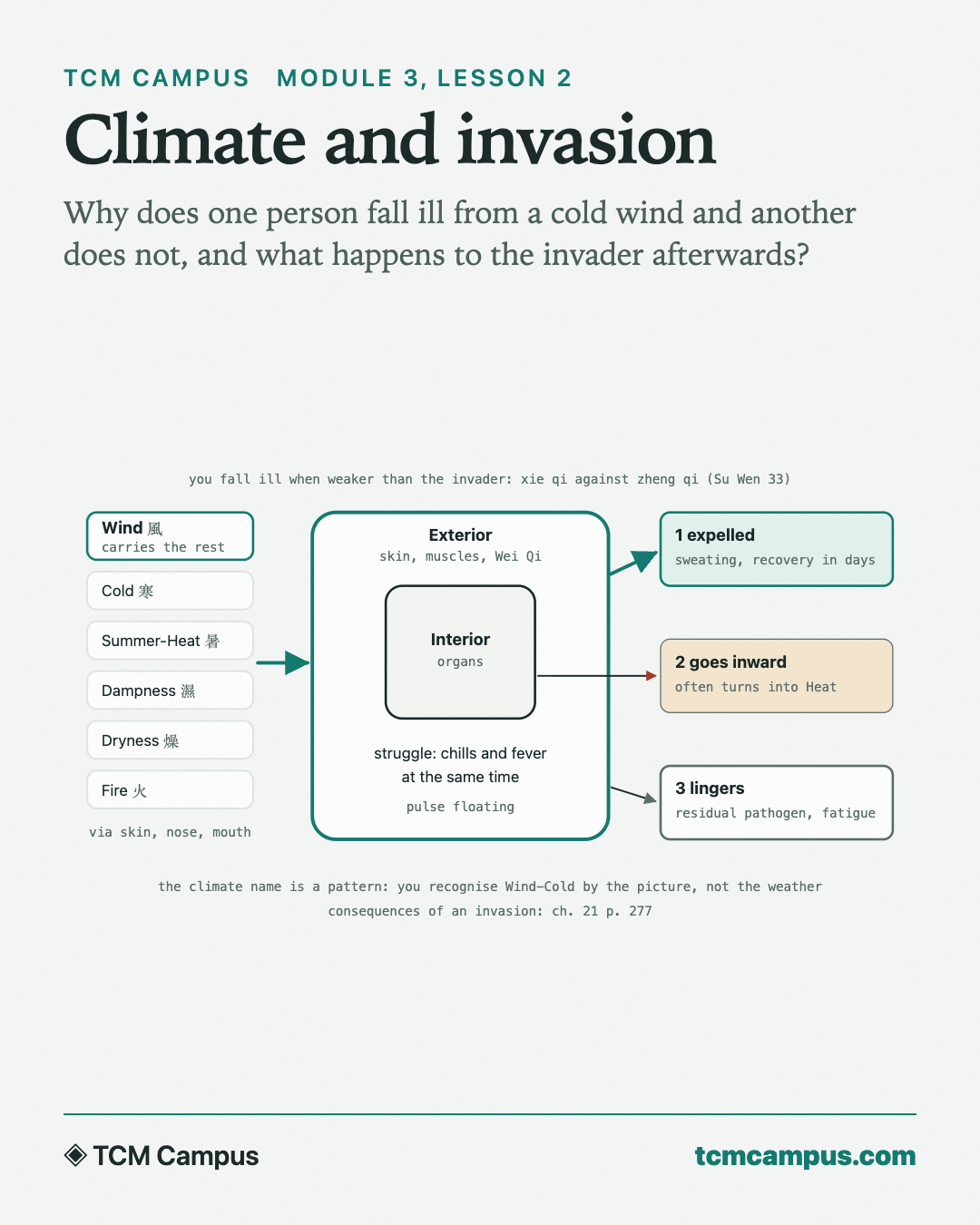
- When climate causes disease. Weather that does not suit the season, is too extreme or lasts too long, or a body that is too weak; always relative. Su Wen 33: where pathogens gather, Qi is deficient. mnemonic: wrong time, too strong, too long, too weak.
- A pattern, not a weather report. You diagnose Wind-Cold from the signs, not from the weather (ch. 21 p. 271). Bacteria and viruses fall within that picture (p. 269).
- Six pathogens. Wind sudden, mobile, upper body, carries the rest; Cold contracts and causes pain; Summer-Heat only in summer, exhausts, often with Dampness; Dampness heavy, sticky, slow; Dryness dries, the Lungs first; Fire rises, dries and causes bleeding.
- The entrance. Through the skin (textbook knowledge: the Shang Han Lun) or through the nose and mouth (the Wen Bing school); the first struggle takes place in the Exterior, where Wei Qi sits.
- Chills and fever at the same time. The sign of an Exterior pattern (p. 274). More chills: Wind-Cold; more fever: Wind-Heat. Pulse floating; the tongue often hardly changes yet. mnemonic: who shivers has Cold; who glows has Heat.
- Three outcomes (p. 277). Expelled; gone inward, where it often turns into Heat; or lingering as a residual pathogen. Do not tonify while the pathogen is still there.
- Red flag. Fever with neck stiffness, drowsiness or pinpoint spots; breathlessness; fever in an infant or after travel far away: see a doctor first.
The rest of this lesson is reference.
Three practice questions from this lesson
According to the book, when does climate cause disease?
- Only in winter, the season of Cold
- When the weather is bad, equally for everyone
- When the climate is stronger than the body
Answer: When the climate is stronger than the body. Always relative: xie qi against zheng qi (ch. 21 p. 268). Weather that does not suit the season, is too extreme or lasts too long, or a body that is too weak. Summer-Heat, by contrast, causes disease only in summer.
Su Wen 33: where pathogens gather ...
- Blood is hot
- Qi is deficient
- Yang is full
Answer: Qi is deficient. A pathogen enters where the zheng qi falls short.
Case. A man cycles through cold rain and the next day has a sore throat, more fever than chills, thirst and slight sweating; pulse floating-rapid. Which pattern?
- Cold inside
- Wind-Cold, because it was cold
- Wind-Heat
Answer: Wind-Heat. A climate name is a pattern: the picture decides, not the weather (ch. 21 p. 271).
The rest of this lesson
In the course you get the step-by-step explanation, 17 case-based practice questions, 18 spaced-repetition flashcards, the pitfalls and the bridge to physiology with evidence grades. This lesson belongs to module 3: Causes.