All lessons Module 1: Foundations Lesson 18
Clinical evidence
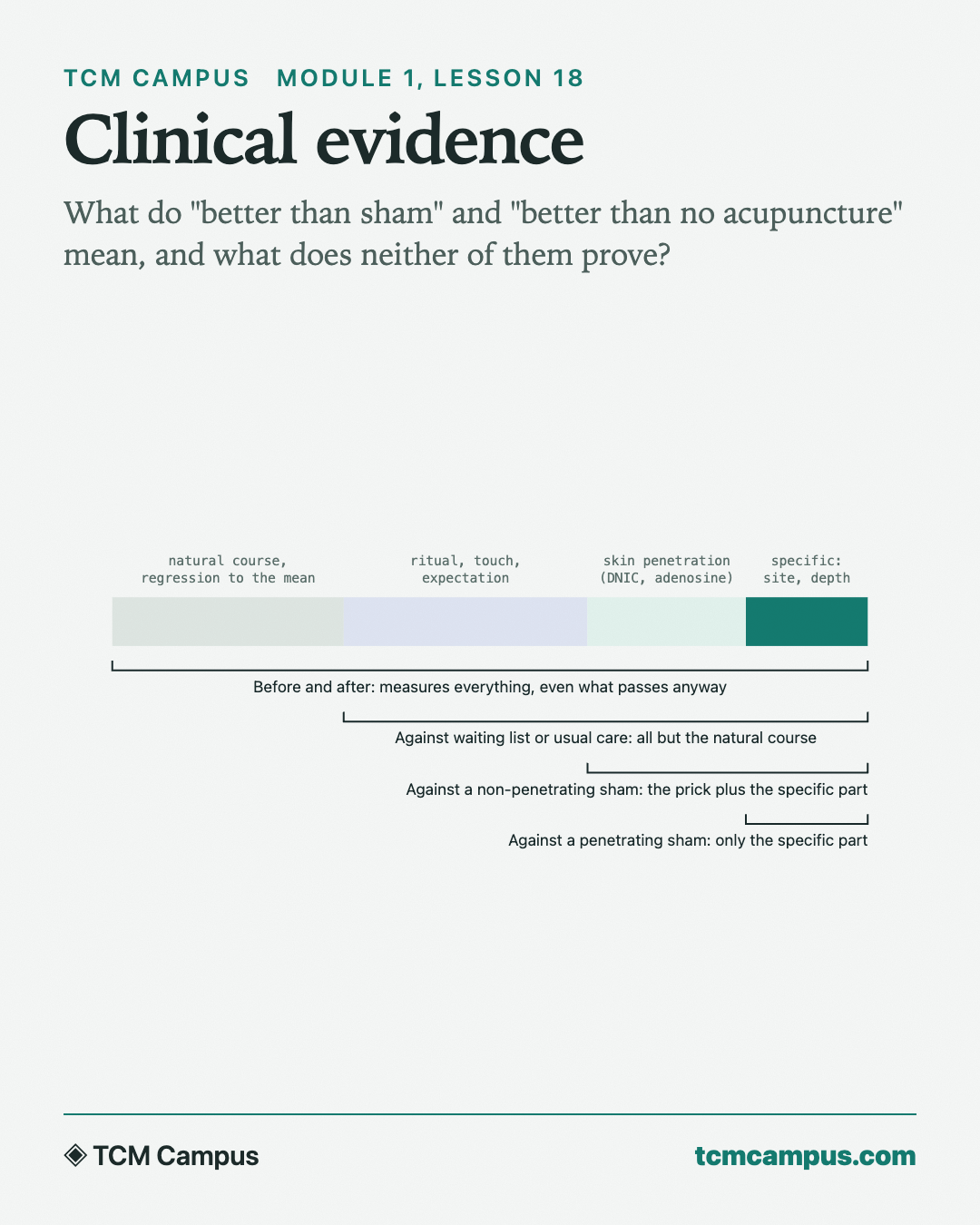
What do "better than sham" and "better than no acupuncture" mean, and what does neither of them prove?
After this lesson you can read a trial as a row of comparisons, give the state of the evidence for each indication with a number, explain why sham is not a placebo pill, and keep effect and explanation apart. No book needed: the studies are the reading; for each study it says whether only the abstract was read.
Know by heart
- Chronic pain, Vickers 2018. About 0.5 SD against no acupuncture, about 0.2 SD against sham; IPD from 39 trials, 20,827 patients. mnemonic: a half against nothing, a fifth against sham.
- Low back pain, GERAC (Haake 2007). Response 47.6 verum, 44.2 sham, 27.4 guideline care; verum minus sham 3.4, not significant. mnemonic: nearly 50, nearly 45, just over 25: the package works, the site not demonstrably.
- Headache, Cochrane (Linde 2016). Migraine: against nothing 41 versus 17 per cent (NNT 4), against sham 50 versus 41 (NNT 11), at least equal to prophylaxis. Tension-type headache: against sham 51 versus 43. mnemonic: migraine NNT 4 against nothing, 11 against sham.
- PONV, PC-6 (Lee 2015). Nausea RR 0.68 against sham, low quality; equal to antiemetics, moderate quality. mnemonic: two thirds of the nausea remains.
- Three positive Chinese trials, one each. Constipation 31.3 versus 12.1 per cent (Liu 2016); stress incontinence 9.9 versus 2.6 grams (Liu 2017); pelvic pain in men 60.6 versus 36.8 per cent (Sun 2021). mnemonic: bowel, bladder, pelvis; one country, one trial each, no replication yet.
- Two negative ones. Knee pain no better than sham laser (Hinman 2014); IVF live birth 18.3 versus 17.8 per cent, RR 1.02 (Smith 2018).
- Context and tailoring. Kaptchuk 2008: 28, 44, 62 per cent (waiting list, ritual, relationship). Cherkin 2009: 4.4, 4.5, 4.4 versus 2.1 (tailoring adds nothing demonstrable). Sham against nothing: 0.39 to 0.45 SD. mnemonic: ritual plus 16, relationship plus 18.
The rest of this lesson is reference.
Three practice questions from this lesson
GERAC. Verum 47.6, sham 44.2, guideline care 27.4 per cent response after six months. What does the difference between sham and guideline care (16.8 points) measure?
- The specific effect of the right points at the right depth
- The weakness of guideline care: medication and exercise therapy work poorly
- The package: ritual, expectation, attention and the needling itself
Answer: The package: ritual, expectation, attention and the needling itself. Sham shares everything with verum except the right site and depth. The difference from guideline care is therefore the package on top of usual care: ritual, expectation, attention and what a needle through the skin does. It says nothing about the choice of points, nor about the value of guideline care.
GERAC. Verum minus sham is 3.4 points, CI -3.7 to 10.3, p = 0.39. What may you say?
- Verum is better than sham, because 47.6 is more than 44.2 per cent
- Acupuncture is placebo: verum and sham do not differ, since p is 0.39
- A specific effect has not been shown, but it has not been ruled out
Answer: A specific effect has not been shown, but it has not been ruled out. The interval includes zero and an advantage of up to about 10 points: zero and a small advantage both fit. A p of 0.39 shows no difference, but failing to show a difference is something else than showing equality; and the sham penetrated, so it was not inert.
In GERAC, anyone who became unblinded or sought other therapy outside the protocol counted as a non-responder. What does that do to the figures?
- It inflates the verum group, because nobody stopped in that arm
- It changes nothing, because the rule only applied to the sham arm
- It makes the response more conservative, and lower, in all three arms
Answer: It makes the response more conservative, and lower, in all three arms. A conservative rule, the same for all three arms: improvement from something else does not count. The percentages are therefore lower than 'feels better', but the comparison stays fair.
The rest of this lesson
In the course you get the step-by-step explanation, 16 case-based practice questions, 18 spaced-repetition flashcards, the pitfalls and the bridge to physiology with evidence grades. This lesson belongs to module 1: Foundations.