All lessons Module 8: Clinical practice Lesson 4
Digestion
Pain that gets better or worse with food, burning or cramping, stools watery or dry: which questions separate the patterns of the Stomach and the Intestines?
After this lesson you know the alarm features in abdominal complaints, you can explain what descending and ascending mean, you can tell apart the patterns of the Stomach and of the Intestines with tongue, pulse and principle, you can explain an example point selection, and you know for which abdominal complaint acupuncture is better than sham and for which it is not.
Know by heart
- Alarm features. Difficulty swallowing, vomiting blood or coffee grounds, black or bloody stools, weight loss, persistent vomiting, anaemia, new complaints after the age of fifty, bowel cancer in the family, diarrhoea at night. mnemonic: follow the food down: swallowing, vomiting, blood, weight; then three about the person: age, family, night.
- Acute abdomen and the heart. Severe pain with a hard abdomen, no more stools or wind, fever: emergency. Pressing pain in the upper abdomen with sweating or breathlessness may be a heart attack: emergency services (112 in Europe, 999 in the UK, 911 in North America).
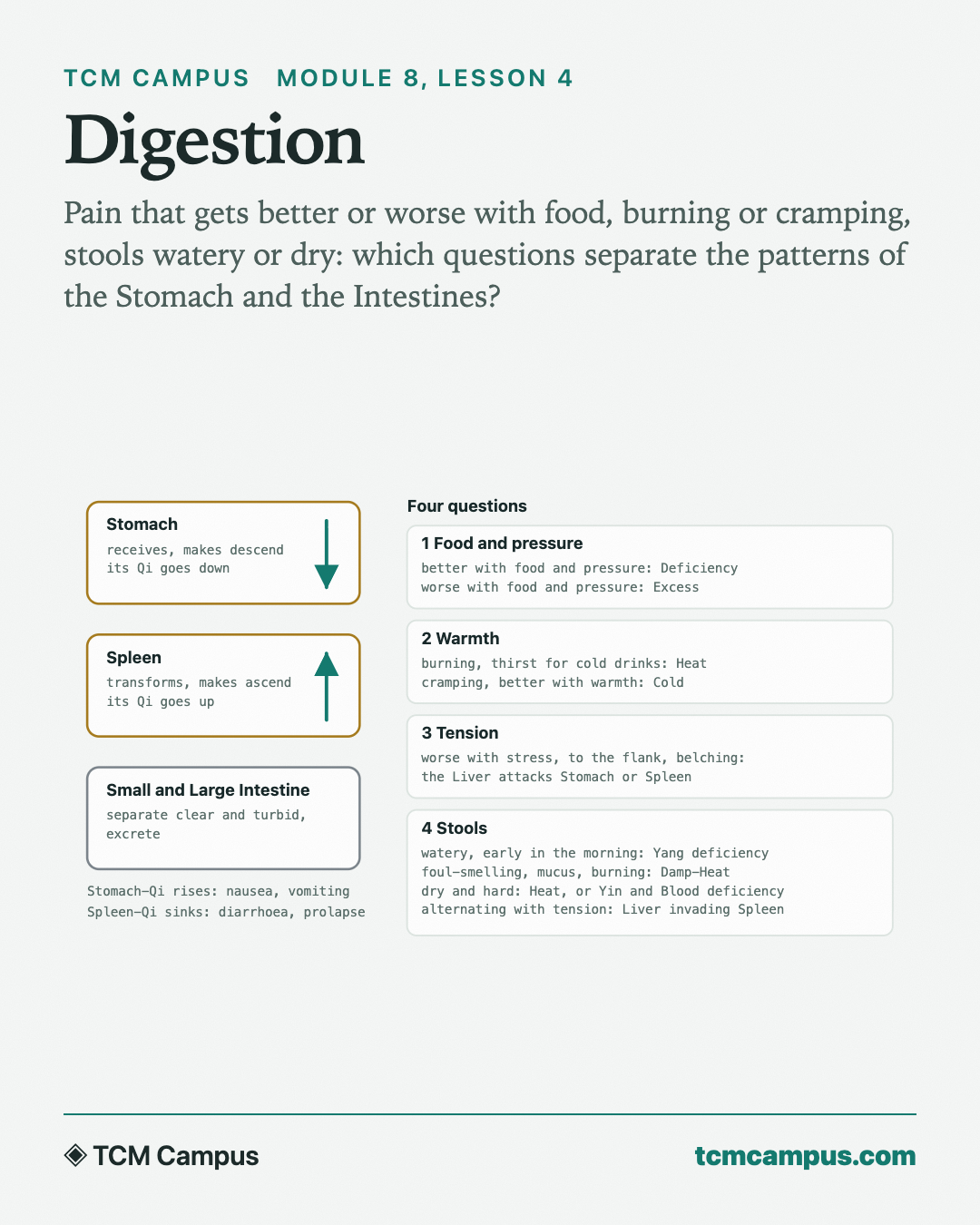
- Descending and ascending. Stomach-Qi rises: nausea, belching, vomiting. Spleen-Qi sinks: diarrhoea, prolapse.
- Four questions. Food and pressure (better is Deficiency, worse is Excess); warmth (burning is Heat, cramping and better with warmth is Cold); tension (the Liver); stools.
- The Stomach. Fire: burning, hunger, bad breath, yellow coating. Yin deficiency: dull burning, dry mouth, no coating in the centre. Cold: cramping, better with warmth, white coating. Retention of Food: full, sour, better after vomiting. Liver invading the Stomach: belching, sour regurgitation, with stress, wiry.
- The Intestines. Damp-Heat: foul-smelling, mucus, burning. Yang deficiency: watery, early in the morning. Liver invading the Spleen: pain and urgency with stress, better after a bowel movement. Constipation: dry (Heat, Yin or Blood), difficult and bloated (Qi stagnation), no strength (Qi deficiency).
- Evidence. Better than sham: postprandial distress syndrome (83 versus 52 per cent, Yang 2020) and severe constipation (31 versus 12, Liu 2016). Not better: irritable bowel syndrome (Manheimer 2012). Hypnotherapy for IBS: 41 versus 17 per cent (Flik 2019).
The rest of this lesson is reference.
Three practice questions from this lesson
Case. A woman of 61 with diabetes: for an hour a pressing feeling in the upper abdomen, nauseous, sweaty, breathless. What do you do?
- Emergency services: possibly a heart attack
- PC-6 for the nausea, then wait and see
- Make Stomach-Qi descend and evaluate tomorrow
Answer: Emergency services: possibly a heart attack. In women and in people with diabetes a heart attack often presents as a stomach complaint: call emergency services (112 in Europe, 999 in the UK, 911 in North America). The emergency comes before any pattern.
Case. A man of 66: for two months difficulty swallowing and five kilos of weight lost. What is this first?
- An alarm feature: GP or primary care doctor, promptly
- Stomach-Yin deficiency with a dry mouth and throat
- Liver-Qi stagnation with a lump in the throat
Answer: An alarm feature: GP or primary care doctor, promptly. Difficulty swallowing and weight loss are alarm features for oesophageal or stomach cancer: GP or primary care doctor, promptly. A lump in the throat or a dry throat does not explain losing five kilos.
What does 'Stomach-Qi rises' mean in TCM terms?
- Hunger, thirst and bad breath
- Diarrhoea and prolapse of organs
- Nausea, belching, vomiting
Answer: Nausea, belching, vomiting. The Stomach should send things down. If its Qi goes up, the food comes back. If Spleen-Qi sinks: diarrhoea and prolapse. Hunger, thirst and bad breath belong to Stomach-Fire.
The rest of this lesson
In the course you get the step-by-step explanation, 16 case-based practice questions, 15 spaced-repetition flashcards, the pitfalls and the bridge to physiology with evidence grades. This lesson belongs to module 8: Clinical practice.