All lessons Module 6: Points Lesson 4
Du Mai and Ren Mai
What can a practitioner do with two vessels along the midline, one carrying all the Yang of the body and the other all the Yin?
After this lesson you know the functions of the Du and Ren, their schematic pathway, their opening pair, their Luo-Connecting point and their main crossing points, you recognise their classical disease picture, and you know when a practitioner chooses one vessel or the other.
Know by heart
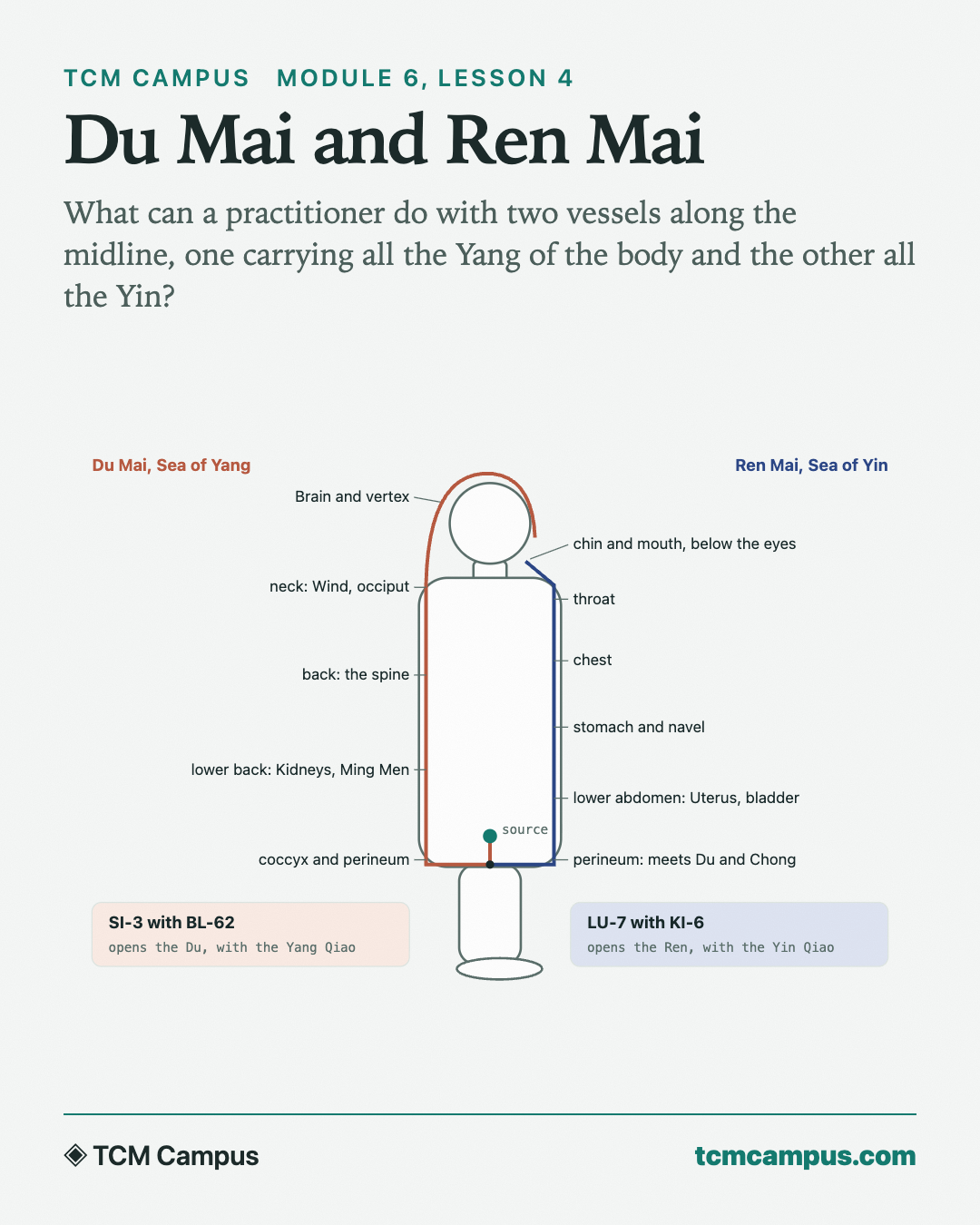
- Du Mai. Sea of the Yang channels; midline at the back, from the perineum via the spine to the Brain, vertex and upper lip. Opening point SI-3, coupled point BL-62; Luo-Connecting point GV-1. mnemonic: Du governs; the backbone of Yang.
- Ren Mai. Sea of the Yin channels; midline at the front, from the perineum over the abdomen, chest and throat to the chin and mouth. Opening point LU-7, coupled point KI-6; Luo-Connecting point CV-15. mnemonic: Ren carries, the Yin and the child.
- Crossing points. CV-1: Ren, Du and Chong. GV-14: all the Yang channels. GV-20: the Du with the Yang channels. CV-3 and CV-4: the three leg Yin. GV-15 and GV-16: the Yang Wei. CV-22 and CV-23: the Yin Wei.
- Six Front-Mu points on the Ren. CV-3 Bladder, CV-4 Small Intestine, CV-5 Triple Burner, CV-12 Stomach, CV-14 Heart, CV-17 Pericardium. mnemonic: three Bs below the navel, Bladder, Bowel, Burner (3, 4, 5); then up the trunk Stomach, Heart, Heart's wrapper (12, 14, 17).
- Nan Jing 29. Du: a stiff spine and jue (fainting, cold limbs). Ren: knots in the abdomen; shan in men, masses in the lower abdomen in women.
- Which vessel when. Du: back and neck along the midline, Kidney-Yang deficiency with a cold back, Wind and the head. Ren: menstruation, fertility and menopause with Yin deficiency, urination, lower abdomen, throat. mnemonic: behind, the Yang that warms; in front, the Yin that nourishes.
- Red flags. Back pain with night pain, fever, neurological loss or numb buttocks; a swelling in the groin or lower abdomen; bleeding after the menopause: see a doctor first.
The rest of this lesson is reference.
Three practice questions from this lesson
Which point opens the Du Mai?
- BL-62
- GV-20
- SI-3
Answer: SI-3. SI-3 opens the Du; BL-62 is the coupled point and opens the Yang Qiao. Both lie on Taiyang.
You open the Ren with LU-7. Which point goes with it?
- KI-6
- SP-4
- PC-6
Answer: KI-6. LU-7 with KI-6: Ren with Yin Qiao, Lungs with Kidneys.
What is the Luo-Connecting point of the Du?
- GV-14
- GV-1
- GV-4
Answer: GV-1. GV-1 Changqiang, at the coccyx. The Luo-Connecting point of the Ren is CV-15.
The rest of this lesson
In the course you get the step-by-step explanation, 16 case-based practice questions, 22 spaced-repetition flashcards, the pitfalls and the bridge to physiology with evidence grades. This lesson belongs to module 6: Points.