All lessons Module 6: Points Lesson 20
Du Mai and the extra points
What makes the Du Mai the governor of the Yang, what do points that lie on no channel at all do, and how does the whole world of points in this module fit together?
After this lesson you know the 28 Du points with name and category, you can choose between GV-4, GV-14, GV-20, GV-24 and GV-26, you know the best-known extra points, and you can survey the 361 points of the fourteen channels with their categories in one table.
Know by heart
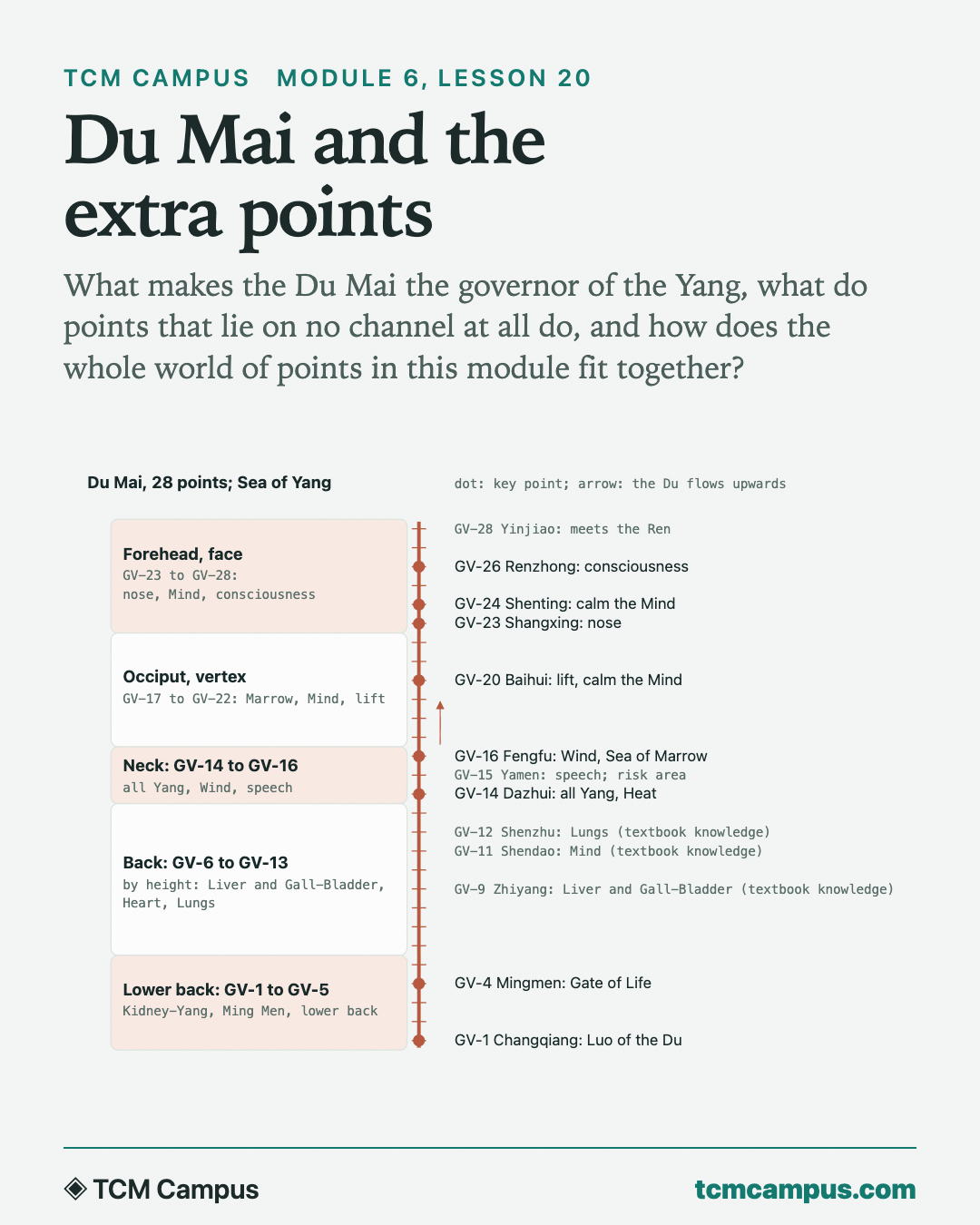
- The vessel. Du Mai, Sea of Yang, governs the Yang channels; 28 points along the midline of the back and head, to the upper lip. Opening point SI-3 (pair BL-62), Luo point GV-1. mnemonic: the Du is the backbone of the Yang.
- Read the height. Lower back: Kidney-Yang and Ming Men. Back: by height, the organ alongside. Neck: all Yang, Wind, speech. Head: Marrow and Mind. Face: nose and consciousness.
- Five key points. GV-4 Mingmen: warm Kidney-Yang, lower back. GV-14 Dazhui: clear Heat, Exterior. GV-20 Baihui: raise Yang, calm the Mind. GV-24 Shenting: calm the Mind. GV-26 Renzhong: restore consciousness. mnemonic: 4 warms, 14 cools, 20 lifts, 24 calms, 26 wakes.
- Seas and windows. GV-20 and GV-16: the Sea of Marrow; GV-14 and GV-15: the Sea of Qi (Ling Shu 33). GV-16 is also a Window of Heaven point.
- Four extra points. Yintang: calm the Mind, sleep. Taiyang: temporal headache, eyes. Sishencong: calm the Mind, sleep, head. Huatuojiaji: a pair beside each vertebra, segment by segment. mnemonic: a hall between the brows, a sun at the temple, four spirits on the crown and Hua Tuo's row down the spine.
- The world of points. Twelve channels with 309 points (on each side), Ren 24, Du 28: 361 in total, plus the extra points. Every point: channel, category, region, pattern, limit.
- Limits. GV-15 and GV-16 are risk areas; in unconsciousness emergency services come before GV-26; high fever with a stiff neck goes to a doctor first.
The rest of this lesson is reference.
Three practice questions from this lesson
How many points does the Du Mai have, and which point opens the vessel?
- 24, LU-7
- 28, BL-62
- 28, SI-3
Answer: 28, SI-3. 28 points; SI-3 opens the Du, with BL-62 (Yang Qiao) as its pair. LU-7 opens the Ren, which has 24 points.
Luo point of the Du?
- GV-4
- GV-14
- GV-1
Answer: GV-1. GV-1 Changqiang. The Luo point of the Ren is CV-15.
Crossing point of all Yang channels, for clearing Heat?
- GV-20 Baihui
- GV-26 Renzhong
- GV-14 Dazhui
Answer: GV-14 Dazhui. GV-14 Dazhui. GV-20 is the crossing point of the Du with the Yang channels at the vertex; GV-26 is the point for consciousness.
The rest of this lesson
In the course you get the step-by-step explanation, 19 case-based practice questions, 22 spaced-repetition flashcards, the pitfalls and the bridge to physiology with evidence grades. This lesson belongs to module 6: Points.