All lessons Module 8: Clinical practice Lesson 9
Evidence per indication, updated
For which complaints has it been shown that acupuncture helps, for which that the real needle in the real place adds something, and where do we not know yet?
The last lesson of the course. After this lesson you can place more than thirty indications on the evidence ladder with their source, read an evidence map critically, argue both sides of the sham debate, know what has and has not been shown, and look back on the whole path of eight modules. No book needed; the literature is the reading.
A class says something about a group in a trial, not about one patient.
Know by heart
- Three questions. Better than nothing (does the package help?), better than sham (does the real needle in the real place do something extra?), better than the alternative (what does the patient choose?). mnemonic: nothing, fake, rival.
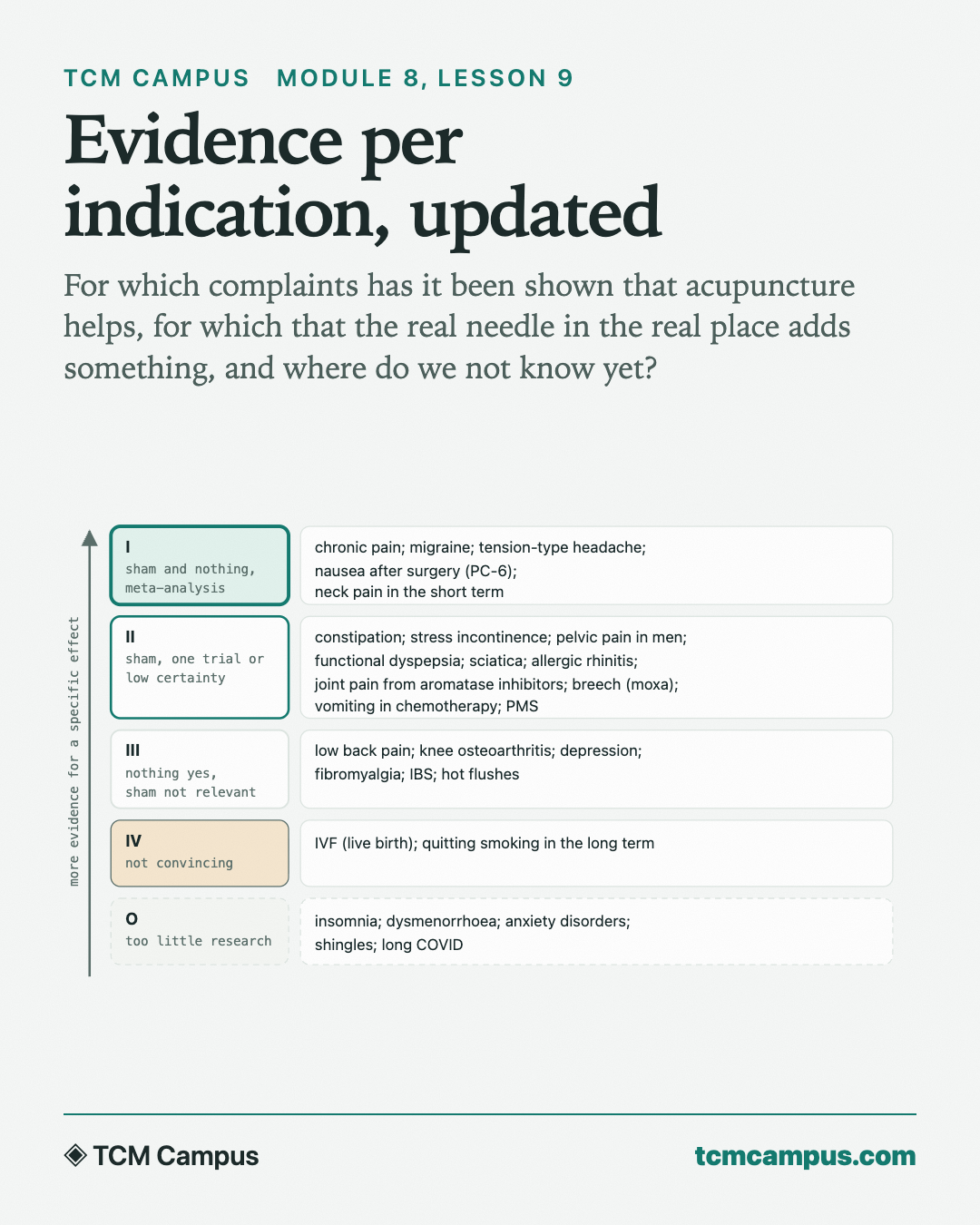
- The classes. I sham and nothing in a meta-analysis; II sham in one trial or with low certainty; III only better than nothing or usual care; IV not convincing even against nothing; O too little research. Certainty (GRADE) is a separate axis.
- Class I. Chronic pain (0.2 SD against sham, 0.5 against nothing); migraine prophylaxis (NNT 11 against sham, at least equal to medication); tension-type headache; PC-6 for nausea after surgery (low certainty); neck pain, short term.
- Classes II and III. II: bowel, bladder and pelvis (one large trial each), sciatica, rhinitis, breech presentation with moxa. III: low back pain, knee osteoarthritis, depression, fibromyalgia, IBS, hot flushes. mnemonic: II is one good trial, III is the package without the place.
- Classes IV and O. IV: IVF (18.3 versus 17.8 per cent), quitting smoking in the long term. O: insomnia, dysmenorrhoea, anxiety disorders, shingles, long COVID.
- Sham, bias, safety. Sham against nothing 0.39 to 0.45 SD; a penetrating sham shrinks the difference; in the past every trial from China, Japan, Hong Kong and Taiwan was positive (Vickers 1998); serious adverse events about 1 per 10,000 patients (Bäumler 2021).
- The three rules of the course. Red flags first; their language first, then translate as a labelled hypothesis; an effect is not an explanation. mnemonic: flag, language, limit.
The rest of this lesson is reference.
Three practice questions from this lesson
A trial compares acupuncture with a non-penetrating imitation. Which question does it answer?
- Does the whole package help more than waiting?
- Does the real needle in the real place add something?
- What does it add alongside usual care, or instead of it?
Answer: Does the real needle in the real place add something?. Against sham you test the specific part: does the real needle in the real place do something the imitation does not? Against nothing or usual care you test the package; against medication or another treatment, the choice.
Migraine prophylaxis: against nothing 41 versus 17 per cent, against sham 50 versus 41 per cent, at least equal to medication, moderate certainty. Which class?
- O
- III
- I
Answer: I. Better than sham and than nothing in a meta-analysis (Linde 2016). Xu 2020 confirmed it in a trial with 150 participants against a non-penetrating sham.
Chronic low back pain: against sham 9 points out of 100 (threshold 15), against no treatment 20 points. Which class?
- Class I
- Class III
- Class IV
Answer: Class III. The package clearly helps, the specific part falls below the clinical threshold (Mu 2020).
The rest of this lesson
In the course you get the step-by-step explanation, 15 case-based practice questions, 17 spaced-repetition flashcards, the pitfalls and the bridge to physiology with evidence grades. This lesson belongs to module 8: Clinical practice.