All lessons Module 8: Clinical practice Lesson 3
Fatigue and chronic illness
Is someone tired because something is missing or because something is in the way, and what has to be investigated medically first?
After this lesson you know the red flags and the medical differential of fatigue, you recognise post-exertional malaise, you can tell the four deficiencies from the excess patterns that make people tired, you know how chronic illness unfolds in TCM terms, you can explain an example point selection, and you know what research on acupuncture and herbs in fatigue shows.
Know by heart
- Red flags. Unintended weight loss, fever, night sweats, swollen glands, blood loss, breathlessness or chest pain, neurological deficit, low mood or thoughts of death, new fatigue after the age of fifty. mnemonic: weight, fever, glands, then four Bs: Blood, Breath, Brain, Blues.
- Have it measured first. In unexplained fatigue: Hb, ferritin, TSH, glucose, an inflammatory marker, kidney and liver; coeliac disease if indicated; and sleep, mood and medication. Worse the day after exertion: post-exertional malaise, think of ME/CFS or long COVID.
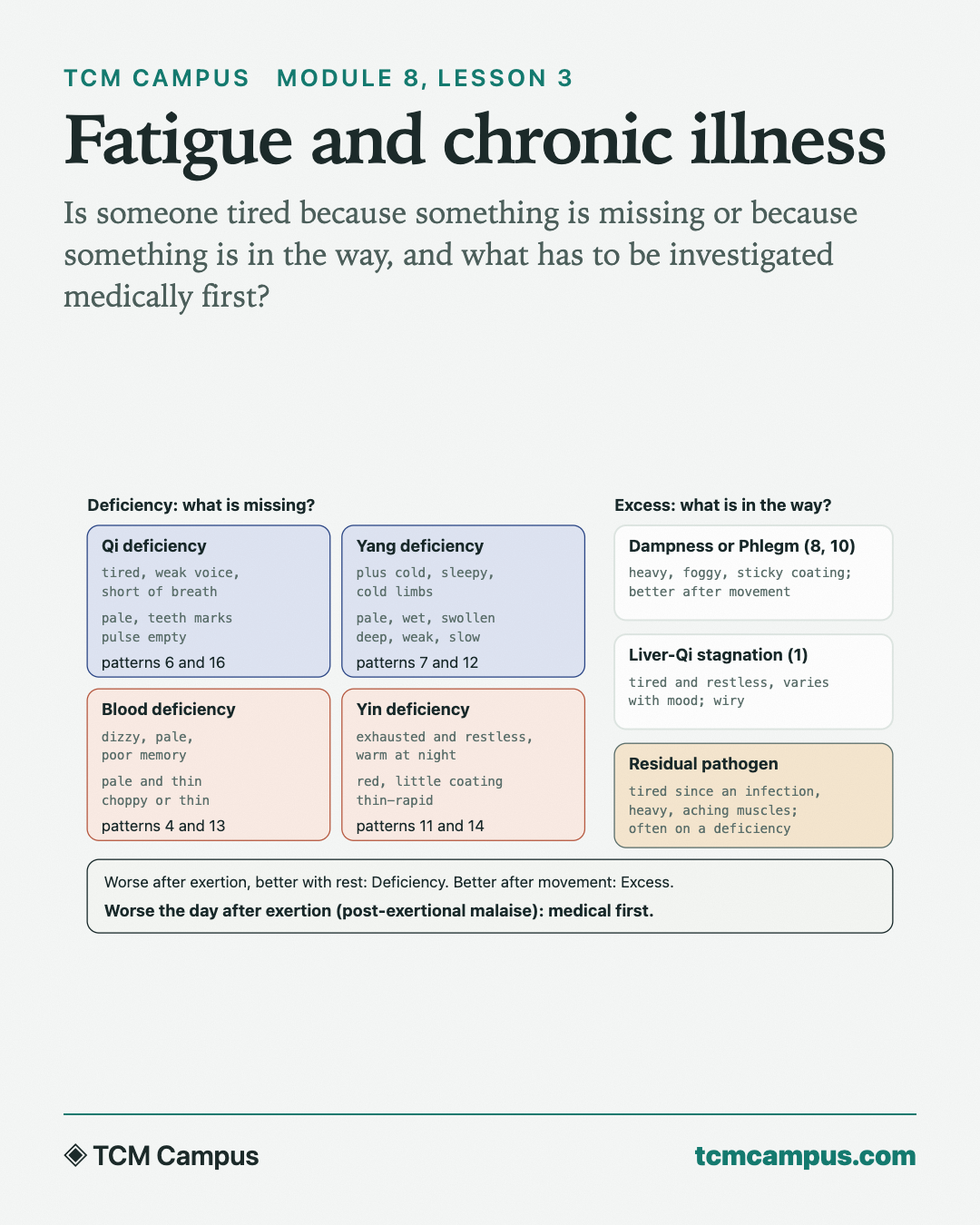
- Deficiency or Excess. Worse after exertion, better with rest: Deficiency. Better after movement, or varying with mood: Excess (Dampness, Qi stagnation).
- The four deficiencies. Qi weak and short of breath; Yang the same plus cold; Blood pale and dizzy; Yin exhausted and restless, warm at night. mnemonic: Qi is weak, Yang is cold, Blood is pale, Yin runs hot.
- Chronic illness (textbook knowledge). Long illness consumes Qi and Yin, reaches the Kidneys and enters the small vessels (Blood stasis). A residual pathogen keeps the fatigue going: do not tonify blindly; expel the pathogen first or at the same time.
- Point selection. Qi: ST-36, CV-6, BL-20. Yang: moxa on CV-4, GV-4, BL-23. Blood: SP-6, BL-17, BL-20. Yin: KI-3, KI-6, SP-6. Dampness: SP-9, CV-12. No moxa in Yin deficiency with Heat.
- Evidence. CFS: acupuncture better than sham with low certainty (Zhang 2019); Si Jun Zi Tang not significant in the ITT analysis (Dai 2024). Cancer-related fatigue: better than usual care (Molassiotis 2012), not better than sham (Deng 2013). Iron without anaemia: less fatigue (Houston 2018).
The rest of this lesson is reference.
Three practice questions from this lesson
Case. A man of 58, tired for three months, has lost five kilos without dieting, sweats at night. Tongue pale; pulse empty. What first?
- Treat for three weeks first, then the GP or primary care doctor
- GP or primary care doctor, promptly
- Tonify Qi with ST-36 and CV-6, review in a month
Answer: GP or primary care doctor, promptly. Unintended weight loss with night sweats are red flags: first prompt investigation of a malignancy or chronic infection. Treating for three weeks or a month delays that. The pattern can be right and the diagnosis still missed.
Which basic tests belong with unexplained fatigue?
- Only Hb and TSH; the rest after three months
- Salivary cortisol, a stool analysis and vitamin D levels
- Hb, ferritin, TSH, glucose, inflammatory marker, kidney and liver
Answer: Hb, ferritin, TSH, glucose, inflammatory marker, kidney and liver. Hb, ferritin, TSH, glucose, an inflammatory marker, kidney and liver, and coeliac disease if indicated. Anaemia, iron deficiency, thyroid, diabetes and inflammation all give a Qi or Blood deficiency picture, so they belong in from the start. A normal result does not make the TCM analysis unnecessary.
Case. A woman of 34: after an afternoon of gardening she is so exhausted the next day that she spends two days in bed; this has been going on for a year. What is this feature called, and what follows?
- Post-exertional malaise: have ME/CFS assessed
- Liver-Qi stagnation: movement frees the stuck Qi
- Qi deficiency: build up exercise a little each week
Answer: Post-exertional malaise: have ME/CFS assessed. A relapse hours to a day after exertion is the core feature of ME/CFS: have it assessed via the GP or primary care doctor. First the diagnosis and agreements about pacing with the doctor; no build-up programme without the doctor. In Qi deficiency rest helps and in Liver-Qi stagnation movement helps straight away; here the relapse only comes the next day.
The rest of this lesson
In the course you get the step-by-step explanation, 15 case-based practice questions, 15 spaced-repetition flashcards, the pitfalls and the bridge to physiology with evidence grades. This lesson belongs to module 8: Clinical practice.