All lessons Module 1: Foundations Lesson 13
From finding to treatment principle
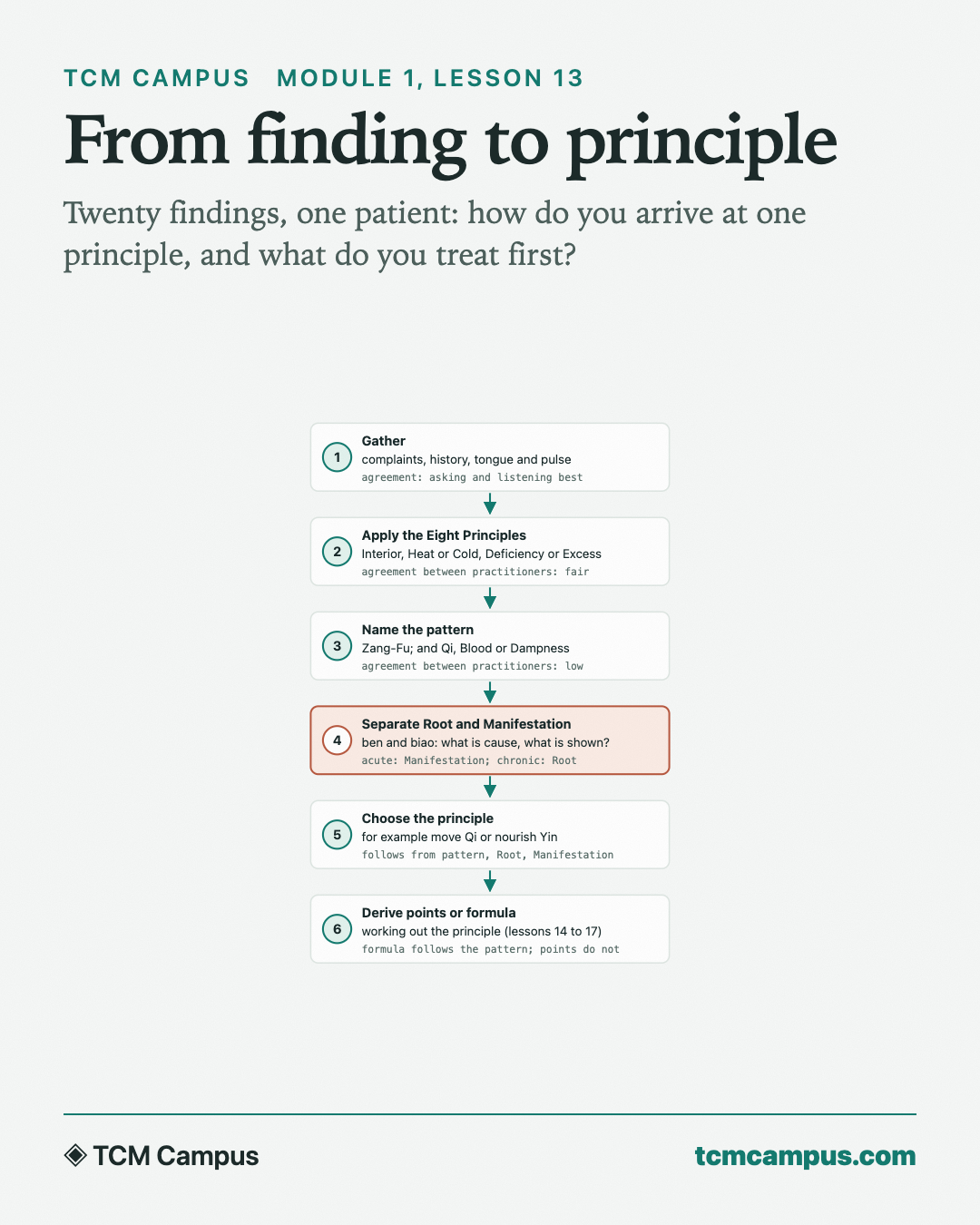
Twenty findings, one patient: how do you arrive at one principle, and what do you treat first?
After this lesson you can work through a case in six steps, separate the Root from the Manifestation, and give two hypotheses for each case with the information that decides between them.
Know by heart
- The six steps. Gather; Eight Principles; pattern; Root and Manifestation; principle; points or formula. mnemonic: from broad to narrow; three Ps (pattern, principle, points), with Root and Manifestation in between.
- Ben and biao. 本 ben is the Root; 标 biao is the Manifestation. mnemonic: 本 is tree 木 with a stroke at the foot; ben as in beneath, biao is what shows above ground.
- The three rules. Acute: the Manifestation first (急则治标); chronic: the Root (缓则治本); often both at once (标本兼治).
- Four pairs of ben and biao. Zheng qi versus xie qi; cause versus complaint; prior versus later illness; interior versus exterior. mnemonic: look up the Root's ZIP Code: Zheng qi, Interior, Prior illness, Cause.
- Six chains, Root first. Kidney-Yin deficiency, then Liver-Yang rising; Spleen-Qi deficiency, then Dampness, then Phlegm; Qi stagnation, then Blood stasis; prolonged Heat, then Yin deficiency; Liver-Qi stagnation, then Liver invading the Spleen; Spleen-Qi deficiency, then Blood deficiency, then Heart-Blood deficiency. mnemonic: whatever comes first is the Root; Qi stagnation and Heat are the Excess conditions among the Roots.
- Two axes. Root and Manifestation say what comes first; tonifying (bu) or draining (xie) says which direction. mnemonic: 闭门留寇, do not lock the door with the robber inside.
- The format of a case answer. Red flag; hypothesis 1; hypothesis 2; what decides; for each hypothesis Root, Manifestation and principle.
The rest of this lesson is reference.
Three practice questions from this lesson
Kidney-Yin deficiency and Liver-Yang rising in the same patient. What is the Root?
- Neither; they are unrelated
- Liver-Yang rising
- Kidney-Yin deficiency
Answer: Kidney-Yin deficiency. The Root in the deficiency, the Manifestation in the headache. The Yin no longer holds the Yang, so the Yang rises.
Spleen-Qi deficiency, Dampness and Phlegm. What is the Root here?
- The Phlegm, because it causes the complaints
- Dampness
- Spleen-Qi deficiency
Answer: Spleen-Qi deficiency. Spleen-Qi deficiency produces Dampness, Dampness produces Phlegm; the impaired transformation lets fluids accumulate. The Phlegm causes the complaints, but it is the Manifestation: if you only resolve Phlegm, you see it come back. That is why the principle in Damp-Phlegm is 'resolve Phlegm, tonify the Spleen': Manifestation and Root together (pattern 10).
Prolonged Heat has consumed the Yin. What is the Root?
- Neither; Heat and Yin deficiency are unrelated
- The Heat: an Excess can also be the Root
- The Yin deficiency, because Deficiency is always the Root
Answer: The Heat: an Excess can also be the Root. Prolonged Heat leads to Yin deficiency. The Root is what came first and causes the other; that can be an Excess. In practice you often treat both here: clear Heat and nourish Yin.
The rest of this lesson
In the course you get the step-by-step explanation, 37 case-based practice questions, 20 spaced-repetition flashcards, the pitfalls and the bridge to physiology with evidence grades. This lesson belongs to module 1: Foundations.