All lessons Module 2: Organs Lesson 9
Gall-Bladder and Bladder
How can one organ store bile and also take decisions, and what does the Bladder do that the Kidneys do not do themselves?
After this lesson you can name the three functions of the Gall-Bladder and the function of the Bladder, explain why the Gall-Bladder appears on two lists, and tell deficiency from excess in urinary complaints.
Know by heart
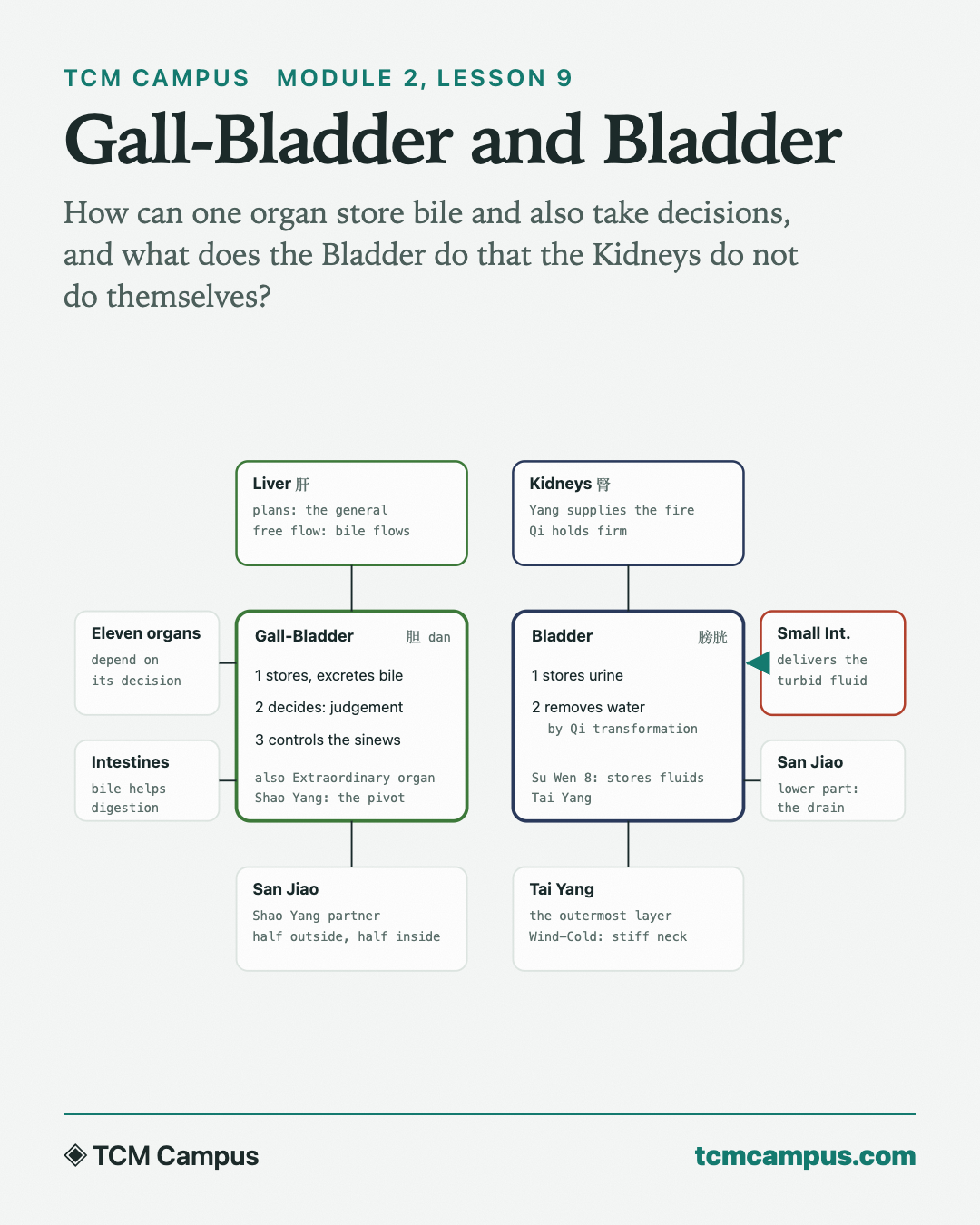
- Gall-Bladder, three functions. Stores and excretes bile; controls judgement (deciding); controls the sinews. mnemonic: bile, verdict, sinew.
- Two lists. A Fu of the Liver and also an Extraordinary organ: it stores a pure fluid and receives no food (lesson 11 of this module).
- Liver and Gall-Bladder. The Liver plans, the Gall-Bladder decides (Su Wen 8); all eleven organs depend on its decision (Su Wen 9); bile flows when Liver-Qi flows freely. mnemonic: the general and the judge.
- Gall-Bladder deficiency. Indecisive, easily startled, quickly discouraged; Wen Dan Tang means "warming the Gall-Bladder".
- Bladder. Stores urine and removes water by Qi transformation, with Kidney-Yang. mnemonic: the reservoir with the Kidneys' tap.
- Bladder: deficiency or excess. Deficiency: a lot of clear urine, nocturia, dribbling, leaking (Kidneys, pattern 12). Excess: burning, urgent, dark or cloudy (Damp-Heat, pattern 9).
- Six Stages. Gall-Bladder with Triple Burner: Shao Yang, the pivot; Bladder with Small Intestine: Tai Yang, the outermost layer (pattern 17).
The rest of this lesson is reference.
Three practice questions from this lesson
Which three functions does Maciocia give the Gall-Bladder?
- Storing urine and removing water; bones
- Making bile; planning and strategy; eyes
- Storing and excreting bile; deciding; sinews
Answer: Storing and excreting bile; deciding; sinews. Ch. 16: storing and excreting bile, judgement, the sinews. Making bile and planning belong to the Liver; storing urine and removing water to the Bladder, the bones to the Kidneys.
Why is the Gall-Bladder also listed among the Extraordinary organs?
- It has no channel of its own
- It really belongs to the Kidneys, not the Liver
- It stores a pure fluid and receives no food
Answer: It stores a pure fluid and receives no food. It stores a pure fluid and receives no food: the form of a Fu, the action of a Zang (ch. 19 p. 243; lesson 11 of this module). It does have its own channel and belongs with the Liver.
Su Wen 8: the Liver is the general and the Gall-Bladder...
- the official of the granary, from whom the five tastes come
- the upright official, from whom the decisions come
- the emperor, from whom the clarity of the Mind comes
Answer: the upright official, from whom the decisions come. Paraphrase of Su Wen 8: the Liver plans, the Gall-Bladder decides. The emperor is the Heart; the granary is the Stomach and Spleen, from whom the five tastes come.
The rest of this lesson
In the course you get the step-by-step explanation, 14 case-based practice questions, 15 spaced-repetition flashcards, the pitfalls and the bridge to physiology with evidence grades. This lesson belongs to module 2: Organs.