All lessons Module 4: Diagnosis Lesson 2
Looking: face, eyes, nose, mouth, skin
What does a colour in the face tell you, and where in the face do you look?
After this lesson you can read the five facial colours with their quality, place a colour on the face map, read eyes, nose, ears, mouth, gums, throat, limbs and skin by organ and pattern, and know how reliable seeing colour is.
Know by heart
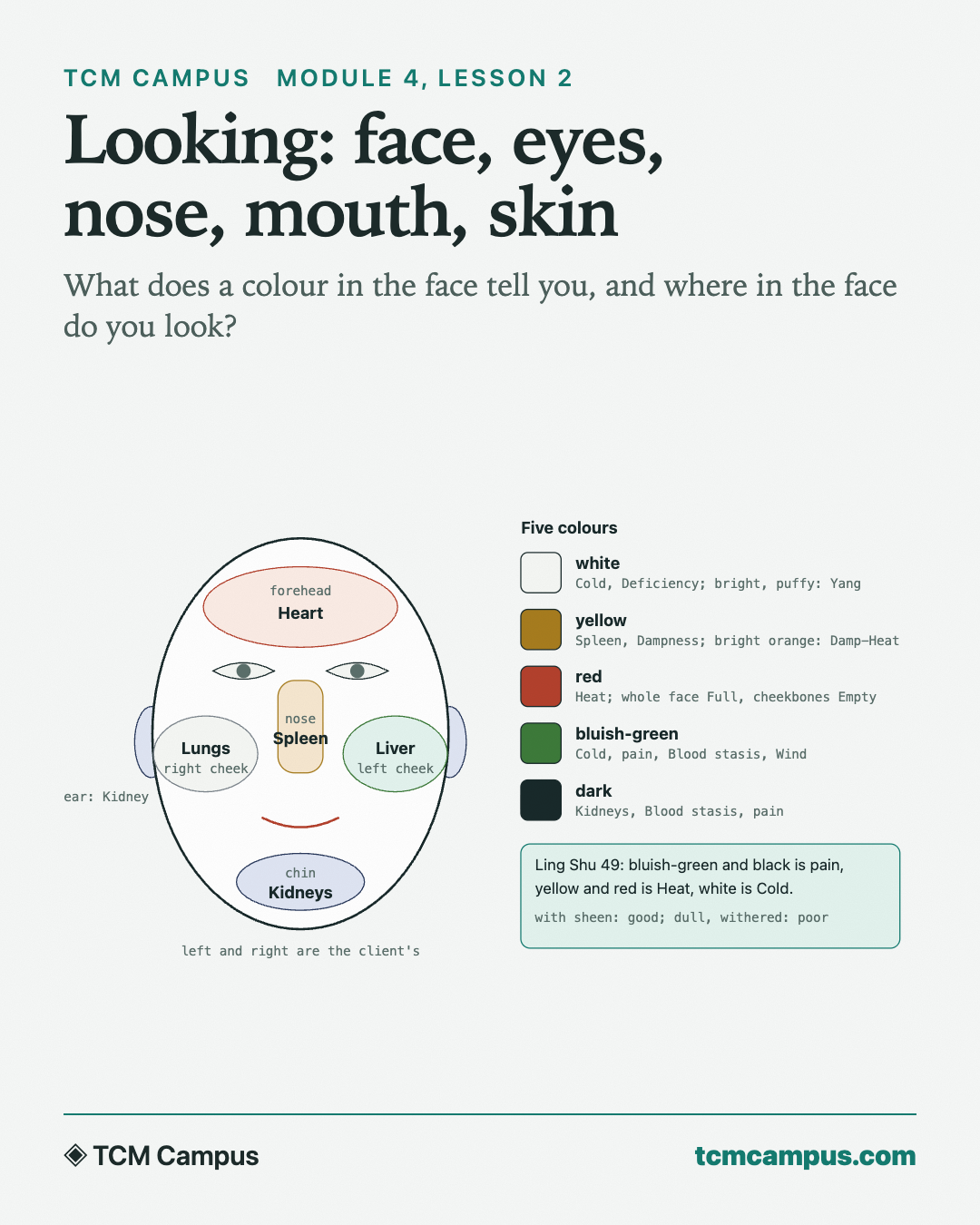
- Five colours. White: Cold and Deficiency (bright and puffy Yang, dull and dry Blood). Yellow: Spleen and Dampness; bright orange Damp-Heat, smoky and dull Damp-Cold. Red: Heat (whole face Full-Heat, only the cheekbones Empty-Heat). Bluish-green: Cold, pain, Blood stasis, Wind. Dark: Kidneys, Blood stasis, pain; mnemonic (Ling Shu 49): dark hurts, warm is red and yellow, white is cold.
- Quality (Ling Shu 49). Sheen favourable, dull unfavourable; superficial Exterior, deep Interior; scattered recent, concentrated long-standing.
- Face map (Su Wen 32). Forehead Heart, left cheek Liver, right cheek Lungs, nose Spleen, chin Kidneys, left and right being the client's; mnemonic: the compass with south at the top: Fire at the top, Water at the bottom, Wood in the east (left), Metal in the west (right), Earth in the centre.
- Five wheels of the eye (Ling Shu 80). Pupil Kidneys (bone), iris Liver (sinews), sclera Lungs (Qi), corners and small vessels Heart (Blood), eyelids Spleen (flesh); mnemonic: from the inside out Water, Wood, Metal, with Fire in the corners and Earth around it all.
- Openings. Nose Lungs (the nose itself also Spleen); ears Kidneys; mouth and lips Spleen; teeth Kidneys; gums Stomach; throat Lungs and Stomach.
- Skin and limbs. Pitting oedema: Yang deficiency. Flat macules: Heat in the Blood; raised papules: Wind-Heat. Dry and scaly: Blood deficiency. Ling Shu 10: bluish-green small vessels on the thenar eminence Cold in the Stomach, red ones Heat.
- Red flags. Yellow sclera, a one-sided facial droop, a red painful eye with reduced vision, pinpoint spots that do not fade under pressure, with fever, blue lips with breathlessness, nasal flaring in a child, a sore that has not healed after three weeks: see a doctor first.
The rest of this lesson is reference.
Three practice questions from this lesson
Which colours does Ling Shu 49 link to pain?
- Yellow and red
- Bluish-green and black
- White and bluish-green
Answer: Bluish-green and black. Ling Shu 49: bluish-green and black is pain, yellow and red is Heat, white is Cold. So white does not belong to pain, not even next to bluish-green.
Red cheeks, only on the cheekbones and mainly in the afternoon and evening; otherwise a pale face.
- Blood stasis (pattern 18)
- Empty-Heat from Yin deficiency
- Full-Heat (patterns 2, 15)
Answer: Empty-Heat from Yin deficiency. Red that stays on the cheekbones is Empty-Heat (patterns 11, 14). A completely red face is Full-Heat (patterns 2, 15); Blood stasis colours dark and purplish.
What distinguishes Yang deficiency from Blood deficiency in the face?
- Nothing; in both the face is simply pale
- Yang deficiency: dull pale and dry; Blood deficiency: bright white, puffy
- Yang deficiency: bright white, puffy; Blood deficiency: dull pale, dry
Answer: Yang deficiency: bright white, puffy; Blood deficiency: dull pale, dry. In Yang deficiency the fluid lingers (puffy, bright white); in Blood deficiency the Blood does not nourish (dull, dry, often thin).
The rest of this lesson
In the course you get the step-by-step explanation, 15 case-based practice questions, 20 spaced-repetition flashcards, the pitfalls and the bridge to physiology with evidence grades. This lesson belongs to module 4: Diagnosis.