All lessons Module 4: Diagnosis Lesson 1
Looking: Mind, body and demeanour
What do you see before someone says a word, and how much can you build on it?
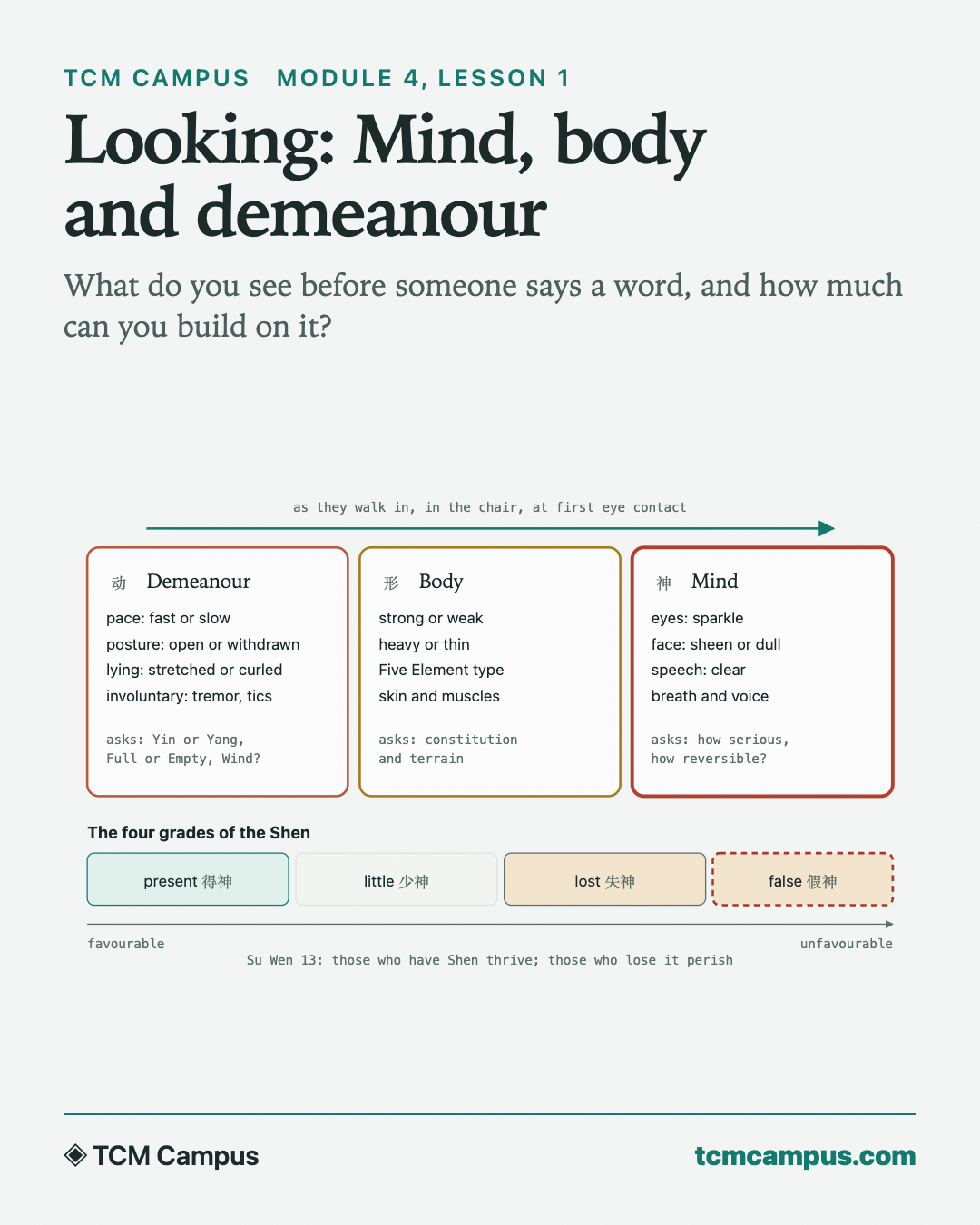
After this lesson you can rate the Shen in four grades, read build and body type through the Five Elements, interpret posture and movement with the Eight Principles, recognise what needs a doctor first as someone walks in, and know which observations two practitioners see the same way.
Know by heart
- Three layers. Demeanour, body, Mind: from the door to the chair to the eyes; mnemonic: first how, then what, then who.
- You see the Shen in three S's. Sparkle in the eyes, sheen on the face, clear speech; mnemonic: sparkle, sheen, speech.
- Four grades (textbook knowledge). Shen present: favourable. Little Shen: Deficiency, reversible. Shen lost: serious. False Shen: a sudden revival in someone who is seriously ill, a bad sign; mnemonic: the candle that flares up one last time.
- Build. Strong: plenty of Qi and Blood. Weak and thin: Deficiency. Heavy and flabby: Qi deficiency with Dampness or Phlegm. Thin and dry: Yin or Blood deficiency, often with Heat; mnemonic (a later saying): heavy people have much Phlegm, thin people much Fire.
- Five types (Ling Shu 64). Wood: long face, straight trunk, greenish. Fire: narrow face, restless, red. Earth: round face, large belly, sturdy legs, yellow. Metal: square face, small shoulders, pale. Water: large head, long back, dark; mnemonic: pole, flame, ball, block, wave.
- Demeanour. Fast, restless, stretched out, throws off the covers: Yang, Heat, Excess. Slow, quiet, curled up, covered: Yin, Cold, Deficiency. Whatever moves involuntarily: Wind; mnemonic: hot sprawls out, cold curls up.
- Red flag. A sudden facial droop or one-sided weakness, confused or drowsy, a seizure: emergency services (112 in Europe, 999 in the UK, 911 in North America). Unintended weight loss or a new tremor: GP or primary care doctor.
The rest of this lesson is reference.
Three practice questions from this lesson
Which three things show the Shen most clearly?
- Sparkle in the eyes, sheen on the face, clear speech
- Height, weight and body type
- The tongue colour, the pulse and the sound of the voice
Answer: Sparkle in the eyes, sheen on the face, clear speech. Eyes, face and clarity of mind: sparkle, sheen, speech. Tongue and pulse are examinations of their own; height and type belong to the body.
Case. Man, 78, bedridden for weeks and barely responsive, is suddenly clear today, asks for his favourite food and has a flush on his cheeks. How does textbook knowledge read this?
- False Shen: alert the doctor and the family
- Shen present: a favourable sign, he is recovering
- Little Shen: Qi and Blood deficiency, reversible
Answer: False Shen: alert the doctor and the family. A sudden revival in someone seriously ill, while the other signs do not follow, is called false Shen: the last Yang breaking loose, an unfavourable sign. Real recovery is gradual and shows in all signs at once; little Shen is dull and slow, not a sudden revival.
A client lies curled up on the treatment table, asks for a blanket and turns his face to the wall. Which direction?
- Yin: Cold and Deficiency
- Wind: what moves involuntarily
- Yang: Heat and Excess
Answer: Yin: Cold and Deficiency. Curled up, covered, facing the wall: Yin. Someone who is hot lies stretched out and throws off the covers. Wind is whatever moves involuntarily or trembles; you do not see that here.
The rest of this lesson
In the course you get the step-by-step explanation, 14 case-based practice questions, 21 spaced-repetition flashcards, the pitfalls and the bridge to physiology with evidence grades. This lesson belongs to module 4: Diagnosis.