All lessons Module 1: Foundations Lesson 19
Mechanisms
Along which route can a needle do something, in which model has that been seen, and what does that route not prove?
After this lesson you can place every mechanism study on a level and in a model, and say what Liu 2021 does and does not show. No book pages: the source is the literature in the lesson.
Know by heart
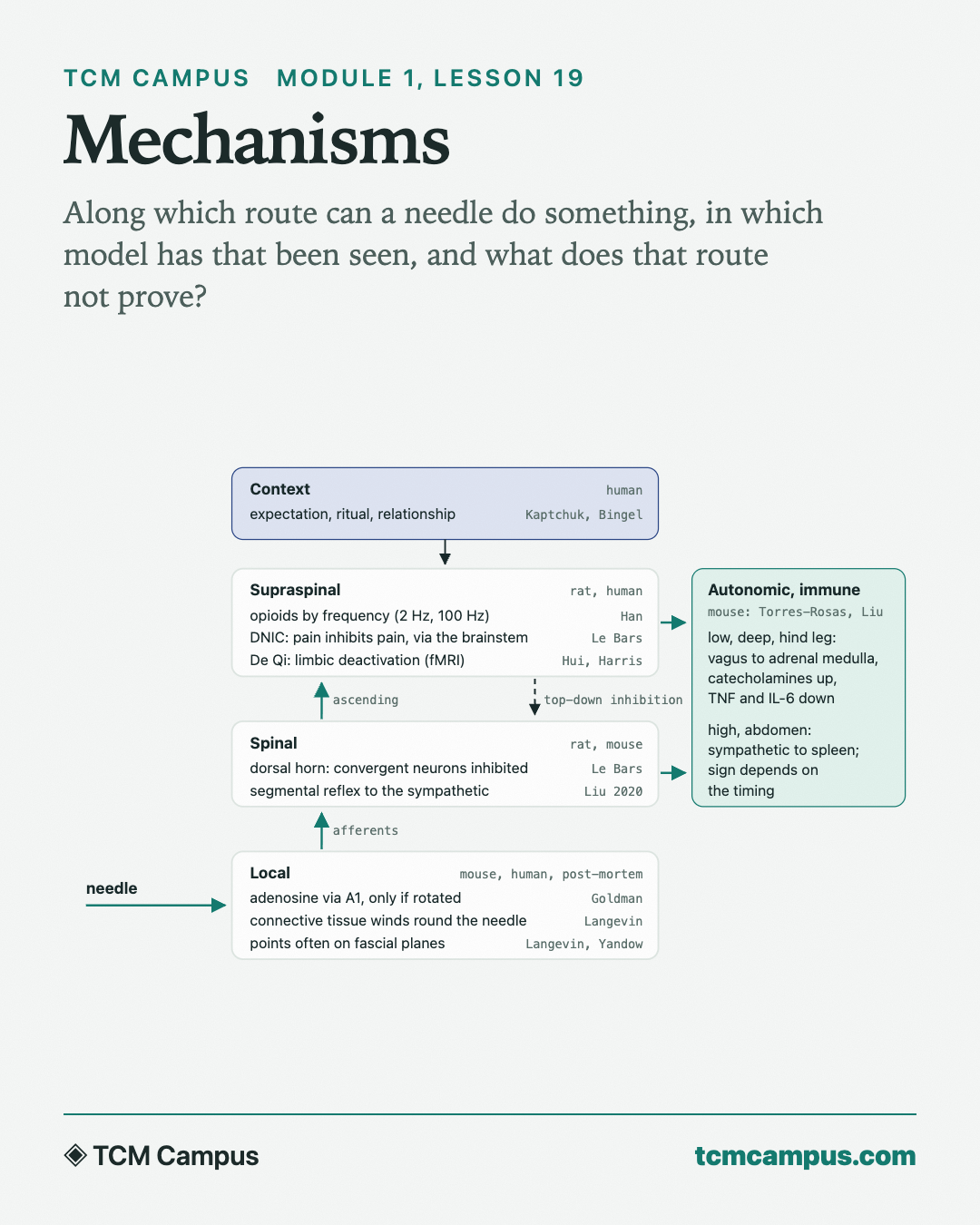
- The five levels, from bottom to top. local, spinal, supraspinal, autonomic and immune, context; mnemonic: from prick to person.
- Local. adenosine via A1, only with rotation (Goldman 2010; mouse, A); the needle winds up connective tissue (Langevin 2001 and 2002; human and rat, B); 80 per cent of arm points on a connective tissue plane, without a baseline (Langevin and Yandow 2002; post-mortem, B).
- Spinal and supraspinal. 2 Hz releases enkephalin, beta-endorphin and endomorphin, 100 Hz dynorphin (Han; rat, and cerebrospinal fluid in humans after TENS, B); pain elsewhere inhibits pain via the brainstem, DNIC, not point-specific (Le Bars 1979; rat, A); mnemonic: two Hz, three Es; a hundred Hz, one D.
- The brain in humans (B). De Qi gives limbic deactivation, sharp pain gives activation (Hui 2000; fMRI, 13 healthy volunteers); verum increases μ-opioid receptor binding, sham does not (Harris 2009; PET).
- Autonomic and immune (mouse, A). gentle and deep on the leg: PROKR2 fibres, vagus, adrenal medulla, dopamine, less TNF and IL-6 (Torres-Rosas 2014, Liu 2021); hard on the abdomen: sympathetic to the spleen, inhibitory before LPS, harmful after LPS (Liu 2020); mnemonic: gentle on the leg calms, hard on the belly rouses; rouse during the fire and you fan the flames.
- Context. an active component in its own right: a warm relationship 62 against 44 per cent with sham (Kaptchuk 2008; RCT); expectation doubles or abolishes the effect of remifentanil (Bingel 2011).
- The letter and the limit. A says how the evidence was obtained, not in whom: write "A (mouse)"; B is indirect or associative, C an analogy; nothing here demonstrates channels or a clinically large effect in humans.
The rest of this lesson is reference.
Three practice questions from this lesson
Goldman 2010. Model and route?
- Rat; dynorphin in the spinal cord
- Mouse; adenosine via A1 receptors
- Human; endogenous opioids via the brainstem
Answer: Mouse; adenosine via A1 receptors. Mouse, with adenosine around the point: it rose about 24-fold during the session at ST-36, and without the A1 receptor there was no pain inhibition. Opioids and dynorphin belong to other studies (Han).
In Goldman, pain inhibition did not occur in...
- mice given naloxone, and with a needle at a non-point
- mice after vagotomy, and with a needle that carried no electrical current
- mice without the A1 receptor, and with a needle that was not rotated
Answer: mice without the A1 receptor, and with a needle that was not rotated. Insertion alone was not enough; rotation released the purines. Vagotomy and naloxone were not tested in this study.
What did Goldman not show?
- That the effect only occurs on the same side
- That adenosine rises about 24-fold during the session
- That the site of the point itself matters
Answer: That the site of the point itself matters. There was no non-point for comparison. ST-36 was chosen because it is common in rodent models; a prick elsewhere in the same muscle was not tested, and adenosine after tissue stimulation is not a feature of points. The rise in adenosine and the same-side effect Goldman did show.
The rest of this lesson
In the course you get the step-by-step explanation, 16 case-based practice questions, 18 spaced-repetition flashcards, the pitfalls and the bridge to physiology with evidence grades. This lesson belongs to module 1: Foundations.