All lessons Module 1: Foundations Lesson 7
Patterns 11 to 19: Kidneys, Heart, Lungs, Blood stasis and Bi
Night sweats, palpitations, poor sleep: when is it Kidney-Yin deficiency, when Heart and Kidneys not harmonised, and when Heart-Blood deficiency?
After this lesson you know patterns 11 to 19 by two key symptoms, tongue, pulse and principle, and you can separate the neighbours: three sleep patterns and a Heart-Fire, two Yang deficiencies, deficiency and invasion in the Lungs, three kinds of fixed pain. The features are learning anchors, not validated criteria.
Know by heart
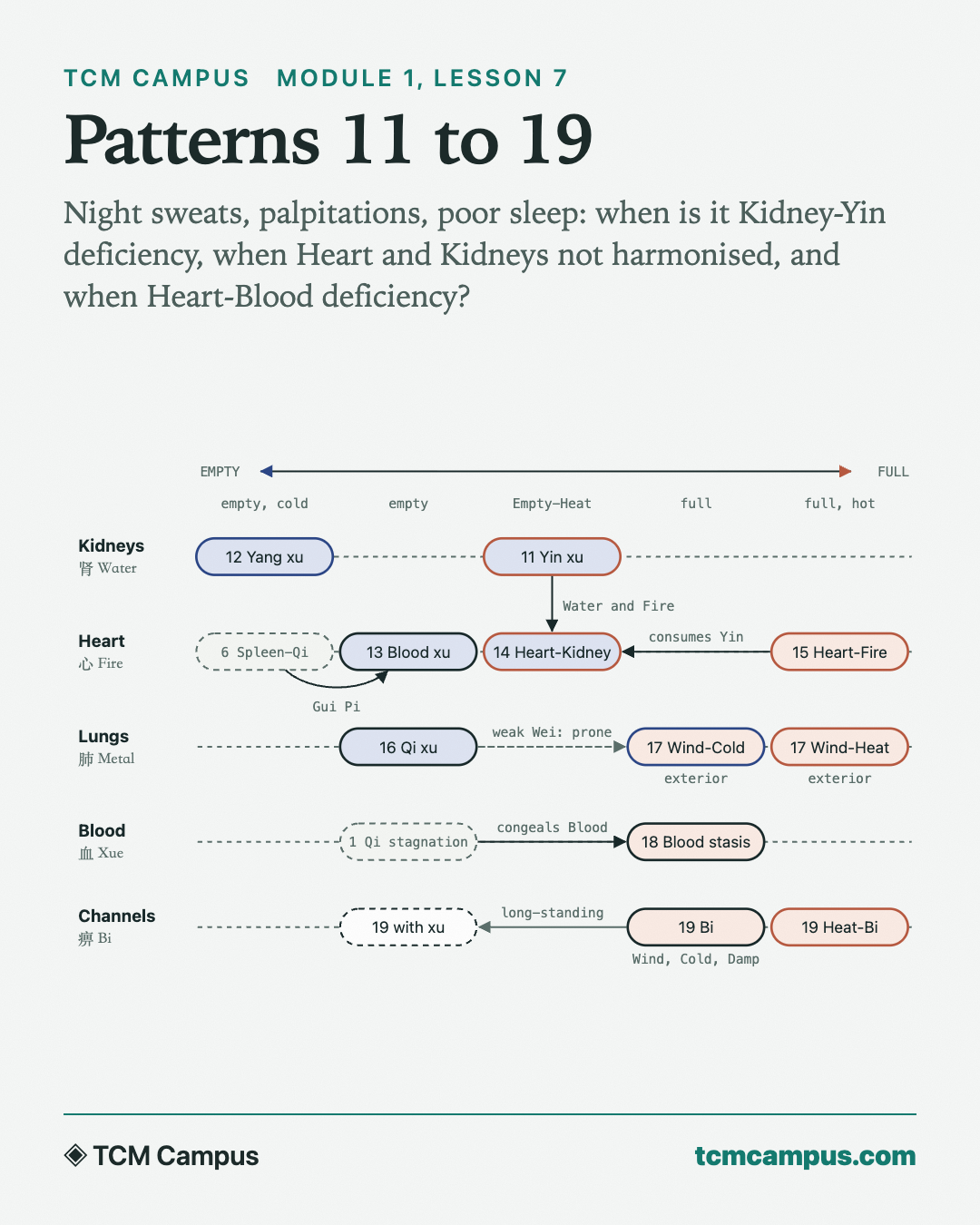
- Kidneys (11 and 12). 11 Yin deficiency: night sweats, weak lower back; red without coating; thin-rapid; nourish Kidney-Yin. 12 Yang deficiency: cold lower back, nocturia; pale, wet, swollen; deep and weak at Chi; warm Kidney-Yang. mnemonic: Yin is warm and dry at night, Yang is cold and wet.
- Heart, the sleep trio (13, 14, 15). 13 Blood deficiency: cannot fall asleep, palpitations; pale and thin; choppy or thin; nourish Heart-Blood, calm the Mind. 14 Heart and Kidneys: wakes in the middle of the night, night sweats; redder tip, little coating; thin-rapid; nourish Kidney-Yin, clear the Heart, calm the Mind. 15 Heart-Fire: sleepless and restless, tongue ulcers; redder tip, yellow coating; rapid, overflowing at Cun; clear Heart-Fire. mnemonic: Off, Through, None (13 cannot drop off, 14 cannot sleep through, 15 barely sleeps at all); the tongue says Pale, Bare, Yellow.
- Lungs (16 and 17). 16 Lung- and Wei-Qi deficiency: spontaneous sweating, always catching colds; pale; empty, right Cun; tonify Lung- and Wei-Qi. 17 Wind-Cold: chills more than fever, stiff neck; tongue normal; floating, tight. 17 Wind-Heat: fever more than chills, sore throat; red tip or sides; floating, rapid. 17 both: release the Exterior. mnemonic: if the pulse floats, it is outside; release first, then tonify.
- 18 Blood stasis. Fixed, stabbing pain that is worse at night, dark clots; purple with distended veins underneath; choppy or wiry; move Blood. mnemonic: everything stands still and turns dark, and the night is Yin.
- 19 Bi, the type by the pain. Wind wandering; Cold severe, better with warmth; Dampness heavy and swollen; Heat red and hot. Tongue and pulse follow the type; expel the pathogen, open the channels; moxa for Cold. mnemonic: Wind wanders, Cold clenches, Damp drags, Heat flares.
- Nine formulas. 11 Liu Wei Di Huang Wan; 12 Jin Gui Shen Qi Wan; 13 Gui Pi Tang; 14 Tian Wang Bu Xin Dan; 15 Dao Chi San; 16 Yu Ping Feng San; 17 Gui Zhi Tang or Ma Huang Tang, with Heat Yin Qiao San; 18 Xue Fu Zhu Yu Tang; 19 Juan Bi Tang, chronic with deficiency Du Huo Ji Sheng Tang. mnemonic: Jin Gui is Liu Wei plus two warmers; Gui Pi: back to the Spleen; Dao Chi: guide out the red; Yu Ping Feng: jade windscreen.
- Three deciders. Little coating is Empty-Heat (11, 14), a yellow coating is Full-Heat (15); a floating pulse is exterior (17); "worse at night" is Blood stasis and a red flag. mnemonic: bare is empty, yellow is full.
The rest of this lesson is reference.
Three practice questions from this lesson
Case. Woman, 63. Cold lower back and knees, always cold, passes clear urine three times a night, swollen ankles, little interest in sex. Tongue pale, wet, swollen. Pulse deep and weak, especially at the rear position.
- 7 Spleen-Yang deficiency
- 11 Kidney-Yin deficiency
- 12 Kidney-Yang deficiency
Answer: 12 Kidney-Yang deficiency. The cold sits in the lower back and knees, the urine is clear and comes at night: Kidney-Yang deficiency. Red flag first: have the nocturia and oedema investigated (heart, kidneys, blood sugar, thyroid, medication).
Case. Woman, 36. Lies awake a long time before she falls asleep, feels her heart beating, is forgetful and easily startled, pale, tired, eats little. Tongue pale and thin. Pulse thin.
- 13 Heart-Blood deficiency
- 14 Heart and Kidneys not harmonised
- 4 Liver-Blood deficiency
Answer: 13 Heart-Blood deficiency. Falling asleep, palpitations, pale and no Heat: Heart-Blood deficiency, with the Spleen involved: the Gui Pi picture. First Hb and ferritin; find out where the Blood is going.
Case. Woman, 27. Shivery since yesterday, hardly any fever, stiff neck, clear runny nose, sneezing, no sweating. Tongue normal. Pulse superficial and tense.
- Wind-Heat
- Wind-Cold
- Lung- and Wei-Qi deficiency
Answer: Wind-Cold. Chills more than fever, stiff neck, clear nasal discharge, floating and tight. Without sweating, the textbook points to Ma Huang Tang. Red flag: a stiff neck with fever, photophobia or drowsiness is meningitis until proven otherwise.
The rest of this lesson
In the course you get the step-by-step explanation, 20 case-based practice questions, 41 spaced-repetition flashcards, the pitfalls and the bridge to physiology with evidence grades. This lesson belongs to module 1: Foundations.