All lessons Module 5: Patterns Lesson 4
Patterns of Qi, Blood and Body Fluids; Phlegm
If you do not know the organ yet: what is going on with the substance, and how does one problem become the next?
Module 1, lesson 3 gave the substances and their pathology in one sentence; this lesson gives the patterns of each substance with tongue, pulse and principle. After this lesson you can distinguish four Qi patterns, four Blood patterns, three problems of the fluids and seven forms of Phlegm, explain bleeding by three mechanisms, and follow the bridges between Qi, Blood and fluids.
Know by heart
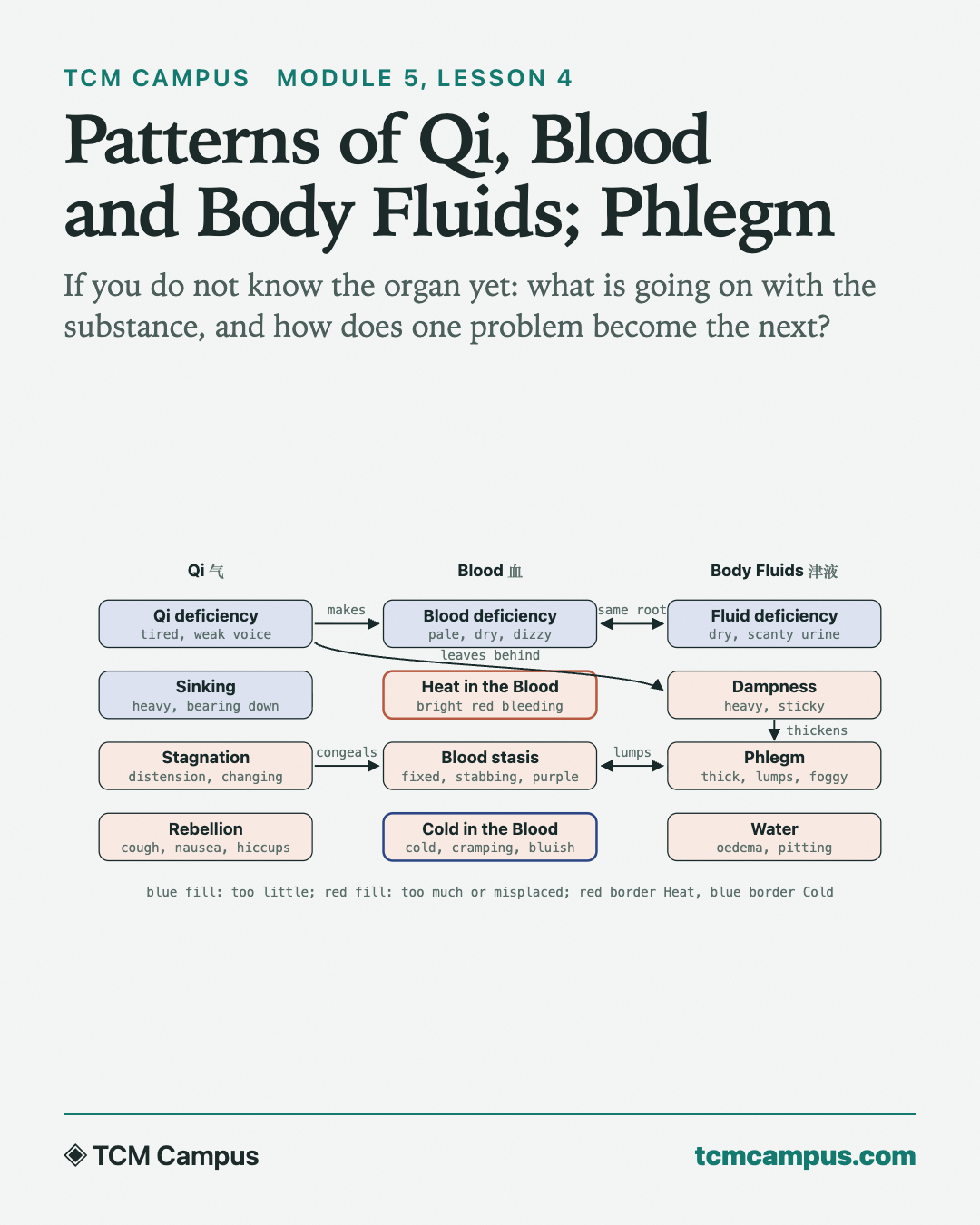
- Four Qi patterns. Deficiency (tired, weak voice, spontaneous sweating; pale; empty); sinking (heavy bearing-down feeling, prolapse); stagnation (distension that comes and goes; wiry); rebellion (cough, nausea, hiccups). Tonify, raise, move, make descend. mnemonic: too little, too low, stuck, the wrong way.
- Four Blood patterns. Deficiency (pale, dry, dizzy; pale and thin; choppy or thin); stasis (fixed, stabbing, worse at night; purple; choppy or wiry); Heat (bright red bleeding, rashes; dark red; rapid); Cold (cold, cramping, dark clots; bluish-purple; deep, tight). Nourish, move, cool, warm. mnemonic: pale, purple, red, blue.
- Three reasons to bleed. Qi fails to hold (light red, dripping, tired); Heat pushes it out (bright red, profuse); stasis blocks (dark, clots, fixed pain). Any unexplained blood loss goes to a doctor first. mnemonic: too weak, too hot, too full.
- Three problems of the fluids. Deficiency (dry, scanty urine; dry tongue); water (oedema: Yang oedema acute and upper via the Lungs, Yin oedema chronic and lower via the Spleen and Kidneys); Dampness and Phlegm. Ling Shu 18: do not make someone who has lost Blood sweat; do not make someone who has sweated a lot lose Blood. mnemonic: Blood and fluids from one source.
- Dampness, Phlegm, water. Dampness is heavy and sinks; Phlegm is thicker, can also rise and forms lumps; water is thin and sits under the skin, pitting under pressure. Phlegm is substantial (sputum) or non-substantial (lumps, channels, the Shen). Textbook knowledge: the Spleen produces Phlegm, the Lungs store it.
- Six kinds of Phlegm and four Phlegm-Fluids. Damp-Phlegm, Phlegm-Heat, Cold-Phlegm, Wind-Phlegm, Dry-Phlegm and Qi-Phlegm; Phlegm-Fluids in the Stomach and intestines, under the ribs, in the limbs, above the diaphragm. mnemonic: Phlegm takes its partner's name, Phlegm-Fluids take the name of their place.
- The bridges. Qi deficiency makes too little Blood and leaves fluids behind; Qi stagnation congeals the Blood; Heat pushes Blood out of the vessels and thickens fluids into Phlegm; Phlegm and stasis together become lumps. mnemonic: Qi leads, Blood and fluids follow.
The rest of this lesson is reference.
Three practice questions from this lesson
Distension and pressing pain in the flank that come and go with mood, versus a fixed, stabbing pain that is worse at night. Which two patterns?
- Qi stagnation versus Blood stasis
- Qi deficiency versus Blood deficiency
- Rebellious Qi versus Heat in the Blood
Answer: Qi stagnation versus Blood stasis. Changing and pressing is Qi that is stuck; fixed and stabbing is Blood that does not flow. Long-standing stagnation becomes stasis.
Case. Man, 34, bright red nosebleeds for a week, red itchy rash, restless, thirsty. Tongue dark red; pulse rapid. Blood count and clotting normal. Which pattern?
- Qi fails to hold the Blood
- Blood stasis
- Heat in the Blood
Answer: Heat in the Blood. Bright red, profuse, with restlessness and a dark red tongue: Heat pushes the Blood out of the vessels. Principle: cool Blood.
Case. Woman, 58, for months light red, thin blood loss that keeps dripping, bruises easily, tired, pale, little appetite. Gynaecologist and blood count have been checked. Which reason to bleed?
- Stasis blocks the pathway
- Qi fails to hold the Blood
- Heat pushes the Blood out
Answer: Qi fails to hold the Blood. Light red, dripping, with signs of the Spleen: the Spleen fails to hold the Blood in the vessels. Bleeding after the menopause always goes to the gynaecologist first.
The rest of this lesson
In the course you get the step-by-step explanation, 17 case-based practice questions, 20 spaced-repetition flashcards, the pitfalls and the bridge to physiology with evidence grades. This lesson belongs to module 5: Patterns.