All lessons Module 6: Points Lesson 16
Pericardium and Triple Burner: the channels and their points
Why does an acupuncturist choose PC-6 for nausea and a tight chest and TE-5 for a fever with a sore throat, and how are these two points connected?
After this lesson you can draw both channels as a line, you know all 32 points by name and category, you can work out PC-6 and TE-5 as key points, and you can explain why the Inner Pass and the Outer Pass mirror each other.
Know by heart
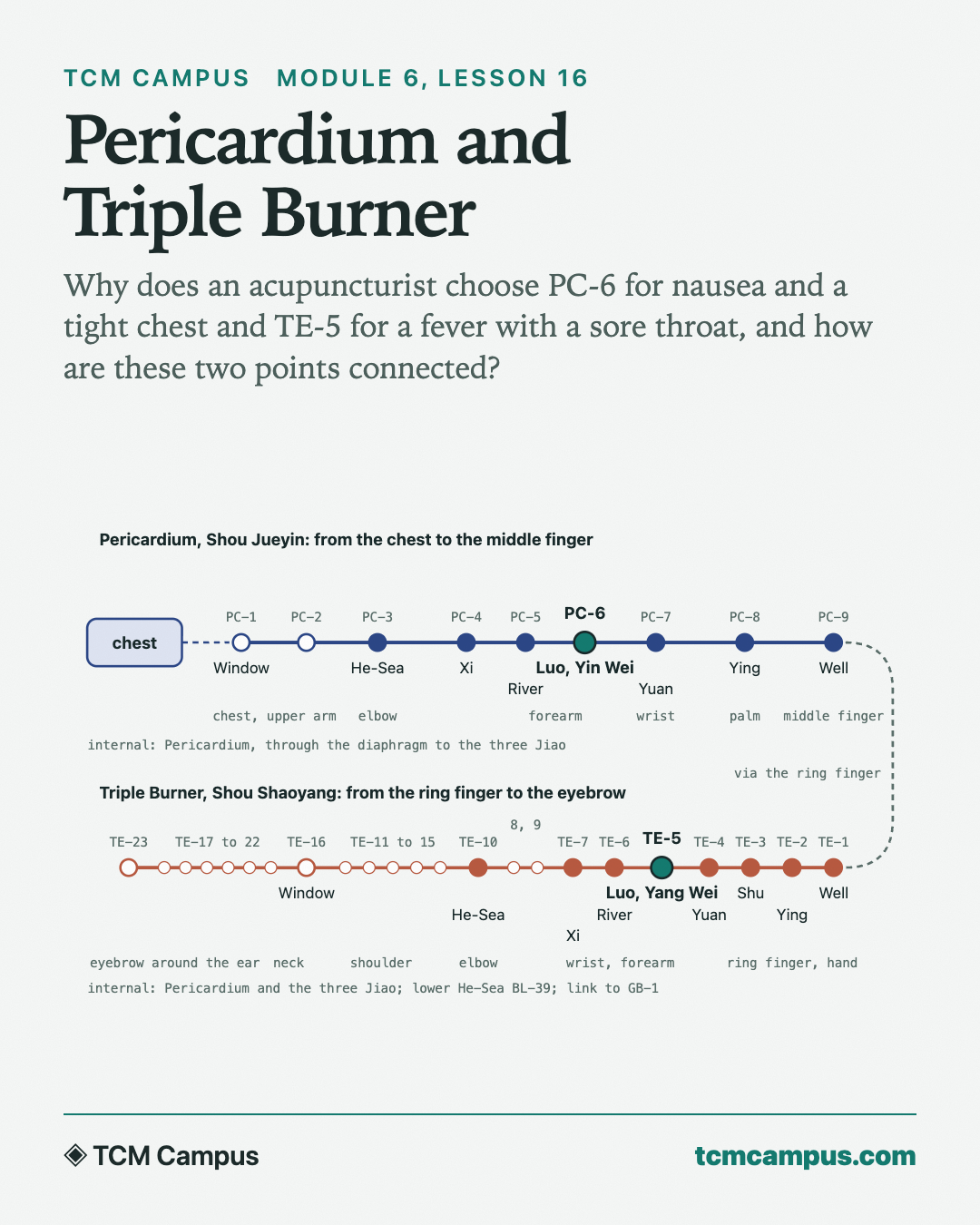
- The course. Pericardium: from the chest via the armpit along the middle of the inner arm to the middle finger. Triple Burner: from the ring finger along the middle of the outer arm, over the shoulder, around the ear to the eyebrow; link to GB-1. mnemonic: the middle of the inside is Jueyin, the middle of the outside is Shaoyang.
- Pericardium in order. PC-9 Jing-Well, PC-8 Ying-Spring, PC-7 Shu-Stream and Yuan, PC-6 Luo, PC-5 Jing-River, PC-4 Xi, PC-3 He-Sea. Back-Shu BL-14, Front-Mu CV-17. mnemonic: back from the finger, 9, 8, 7 in a row, then 6 bridge, 5 river, 4 cleft, 3 sea.
- PC-6 Neiguan, Inner Pass. Luo; opening point of the Yin Wei, partner SP-4; chest, nausea, calm the Shen, make Stomach-Qi descend.
- TE-5 Waiguan, Outer Pass. Luo; opening point of the Yang Wei, partner GB-41; Wind-Heat, Exterior, side of the head. mnemonic: the Inner Pass and the Outer Pass lie opposite each other.
- Triple Burner in order. TE-1 Jing-Well, TE-2 Ying-Spring, TE-3 Shu-Stream, TE-4 Yuan, TE-5 Luo, TE-6 Jing-River, TE-7 Xi, TE-10 He-Sea; lower He-Sea BL-39. Back-Shu BL-22, Front-Mu CV-5. mnemonic: count from 1 to 7, then jump to 10.
- Working points. PC-7 Daling: calm the Shen, Heart-Heat. PC-8 Laogong: Heart-Fire, mouth ulcers. TE-6 Zhigou: hypochondrium and constipation, in pattern 1. TE-17 Yifeng and TE-21 Ermen: the ear.
- Red flag. Chest pain (emergency services: 112 in Europe, 999 in the UK, 911 in North America); vomiting blood or coffee-ground material; sudden deafness; a sudden drooping mouth: a doctor first.
The rest of this lesson is reference.
Three practice questions from this lesson
Which Pericardium point is the Yuan point?
- PC-6 Neiguan
- PC-7 Daling
- PC-8 Laogong
Answer: PC-7 Daling. PC-7, Shu-Stream and Yuan. PC-6 is Luo, PC-8 Ying-Spring.
PC-6 opens which vessel, and with which point does it form a pair?
- Ren Mai; with KI-6 (Yin Qiao)
- Yin Wei; with SP-4 (Chong Mai)
- Yang Wei; with GB-41 (Dai Mai)
Answer: Yin Wei; with SP-4 (Chong Mai). PC-6 opens the Yin Wei, SP-4 the Chong Mai. TE-5 opens the Yang Wei with GB-41 (Dai Mai); LU-7 opens the Ren Mai with KI-6 (Yin Qiao).
TE-5 opens which vessel?
- Du Mai
- Yang Qiao
- Yang Wei
Answer: Yang Wei. TE-5 opens the Yang Wei, partner GB-41 (Dai Mai). BL-62 opens the Yang Qiao, SI-3 the Du.
The rest of this lesson
In the course you get the step-by-step explanation, 16 case-based practice questions, 16 spaced-repetition flashcards, the pitfalls and the bridge to physiology with evidence grades. This lesson belongs to module 6: Points.