All lessons Module 2: Organs Lesson 6
Pericardium, Ming Men and Original Qi
Who protects the Heart, and where does the fire come from that keeps all the organs warm?
A shorter lesson. After this lesson you can name the five headings of ch. 11 and the seven functions of the Fire of the Ming Men, and explain how Yuan Qi, the Original Qi, travels from between the Kidneys to all the organs.
Know by heart
- Five headings of ch. 11. The Pericardium as an organ, as a channel, and the Shen, and the Minister Fire, and the Uterus. mnemonic: shield, channel, spirit, fire, womb.
- Three functions. Protects the Heart; helps the Heart govern Blood; helps the Heart house the Shen. mnemonic: the bodyguard who also lends a hand.
- Three names, two classics. Xin Bao (wrapper), Xin Zhu (Master of the Heart), Tan Zhong (centre of the chest). Su Wen 8: the ambassador, from whom joy comes; Ling Shu 71: what attacks the Heart lands in the Pericardium.
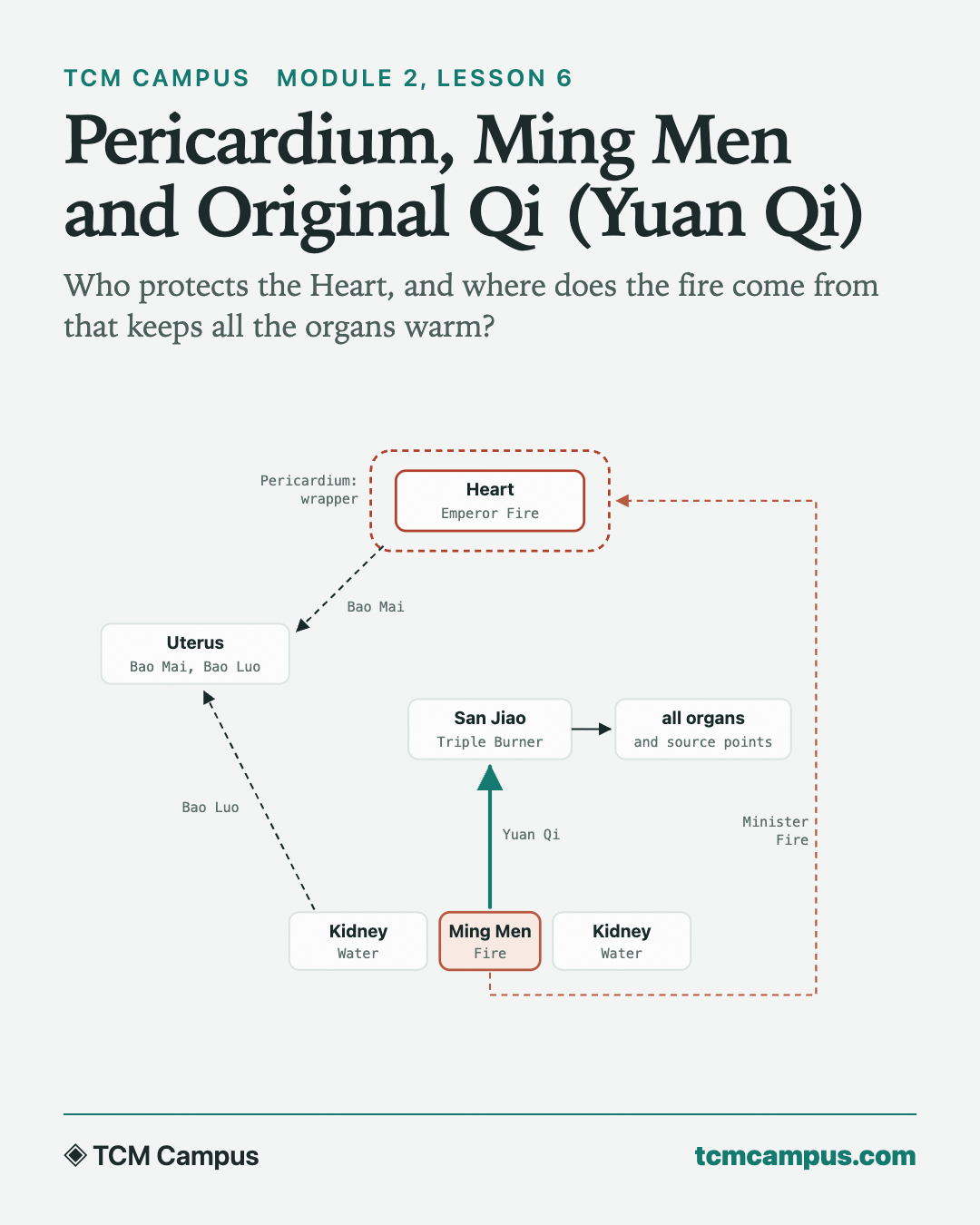
- Yuan Qi. Jing in the form of Qi; arises between the Kidneys (Nan Jing 66), drives all the organs, travels via the San Jiao and emerges at the source points. mnemonic: the source, the messenger, the taps.
- Seven functions of the Fire of the Ming Men. Source of Yuan Qi; Fire for all the organs; warms the Lower Burner and Bladder; warms the Spleen and Stomach; sexuality, Jing and Uterus; helps the Kidneys receive Qi; helps the Heart house the Shen. mnemonic: source, hearth, bladder, kitchen, bed, breath, spirit.
- Two Fires. Emperor Fire: the Heart. Minister Fire: in the Five Elements with the Pericardium and San Jiao, in the Ming Men doctrine the Fire between the Kidneys.
- Where is the Ming Men? Nan Jing 36: the right Kidney; Zhang Jie Bin (1563 to 1640): between the two Kidneys.
The rest of this lesson is reference.
Three practice questions from this lesson
Which five headings does ch. 11 have?
- Organ, channel, Shen, Minister Fire, Uterus
- Organ, channel, Blood, Jing, Uterus
- Functions, correspondences, dreams, sayings, patterns
Answer: Organ, channel, Shen, Minister Fire, Uterus. That is how the table of contents has it: as an organ p. 169, as a channel p. 170, Shen and Minister Fire p. 171, Uterus p. 172.
Ling Shu 71: what happens when a pathogenic factor attacks the Heart?
- It goes to its Fu, the Small Intestine
- It ends up in the Pericardium
- The Heart fights it off itself
Answer: It ends up in the Pericardium. The Heart cannot tolerate a pathogenic factor; the Pericardium intercepts it. The Small Intestine is the Fu of the Heart, but Ling Shu 71 does not speak of it here.
Why does the Neijing often speak of eleven organs?
- The San Jiao then does not count as a Fu
- The Gall-Bladder then counts as an extraordinary Fu
- The Pericardium then counts as a function of the Heart
Answer: The Pericardium then counts as a function of the Heart. Five Zang and six Fu; the Pericardium belongs to the Heart. The San Jiao and the Gall-Bladder simply count among the six Fu.
The rest of this lesson
In the course you get the step-by-step explanation, 14 case-based practice questions, 14 spaced-repetition flashcards, the pitfalls and the bridge to physiology with evidence grades. This lesson belongs to module 2: Organs.