All lessons Module 7: Treatment Lesson 3
Point combinations 1: distal and local, above and below
Why does an acupuncturist choose a point on the foot for a headache, and when the point right at the pain?
After this lesson you know the three ways of choosing points, you can explain when to go distal and when local, you can choose a distal point along the channel, the level or the partner, and you recognise the pairs of above and below with the reason behind them.
Know by heart
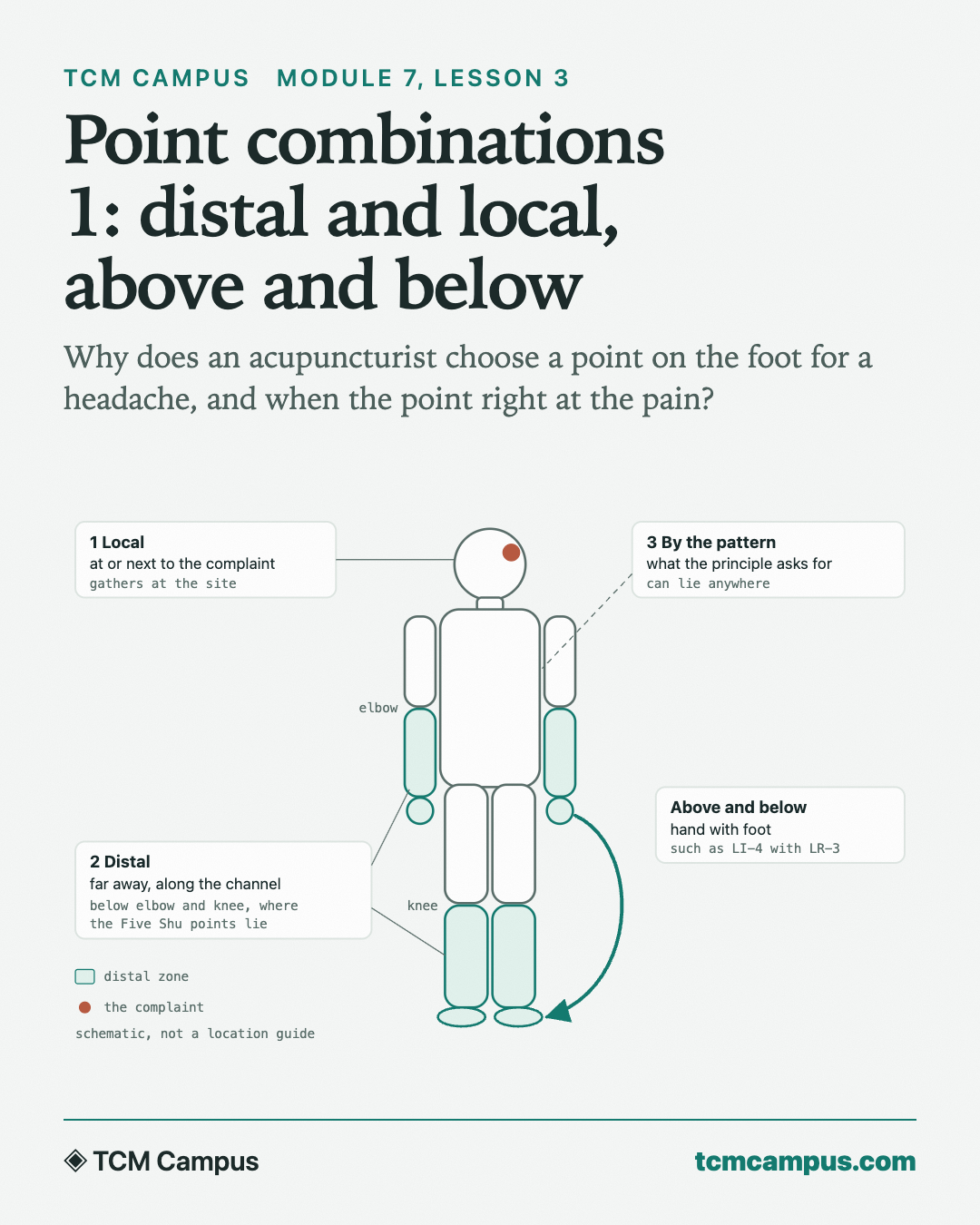
- Three ways of choosing (textbook knowledge). Local: at or next to the complaint. Distal: far away, usually below the elbow or knee. By the pattern: what the principle asks for. A good set often has all three.
- Two textbook sayings. Where the point lies, it works (local). Where the channel runs, its action reaches (distal).
- Distal along three routes. The channel itself; hand and foot of the same level (Taiyang SI-3 with BL-60, Yangming LI-4 with ST-36, Shaoyang TE-5 with GB-34); the paired channel. mnemonic: channel, level, partner.
- Distal is dynamic (textbook knowledge). Strong in acute complaints, Excess and pain, and for bringing something down. Local gathers at the site, often in chronic complaints. Together: far for the root, near for the complaint.
- Command points. LI-4 face and mouth, ST-36 abdomen, LU-7 head and neck, BL-40 back; a rhyme from the Ming period. The book names five (ch. 51 p. 864). mnemonic: four areas, four codes: face LI, belly ST, head and neck LU, back BL.
- Above and below. The Four Gates (LI-4 with LR-3); the opening pairs SP-4 with PC-6, SI-3 with BL-62, TE-5 with GB-41, LU-7 with KI-6. Ling Shu 9: if the disease is above, choose below; if it is in the head, choose at the foot.
- Bringing down, lifting up. Full above and empty below: a point below draws down, such as LR-3 in rising Liver-Yang. If something sinks: GV-20 above lifts the Yang (textbook knowledge, in prolapse).
The rest of this lesson is reference.
Three practice questions from this lesson
What are the three main ways of choosing a point?
- Above and below, left and right
- Adjacent, on the symptom and local
- Local, distal and by the pattern
Answer: Local, distal and by the pattern. Textbook knowledge: at the complaint, far away along the channel, and what the principle asks for. A good set often has all three. Adjacent and on the symptom are variants; above and below, left and right are ways of combining.
Where do distal points usually lie?
- On the trunk, at the Front-Mu points
- On the head and in the neck
- Below the elbow and knee
Answer: Below the elbow and knee. Between fingertip and elbow, toe and knee also lie the Five Shu points (ch. 50). Trunk, head and neck are the places of local points.
Which pair is hand and foot of Taiyang?
- SI-3 with BL-60
- TE-5 with GB-34
- LI-4 with ST-36
Answer: SI-3 with BL-60. Small Intestine and Bladder form Taiyang, the back. LI-4 with ST-36 is Yangming, TE-5 with GB-34 Shaoyang.
The rest of this lesson
In the course you get the step-by-step explanation, 14 case-based practice questions, 15 spaced-repetition flashcards, the pitfalls and the bridge to physiology with evidence grades. This lesson belongs to module 7: Treatment.