All lessons Module 4: Diagnosis Lesson 8
Pulse 2: the 28 qualities
How do you tell 28 pulses apart with three fingers, and which ones are so alike that you confuse them?
After this lesson you can describe a pulse in eight features, you know the 28 qualities in six families, you know for each quality how it feels, what it means and what you confuse it with, you recognise the three irregular pulses as a reason for an ECG, and you know which qualities can be felt reliably.
Know by heart
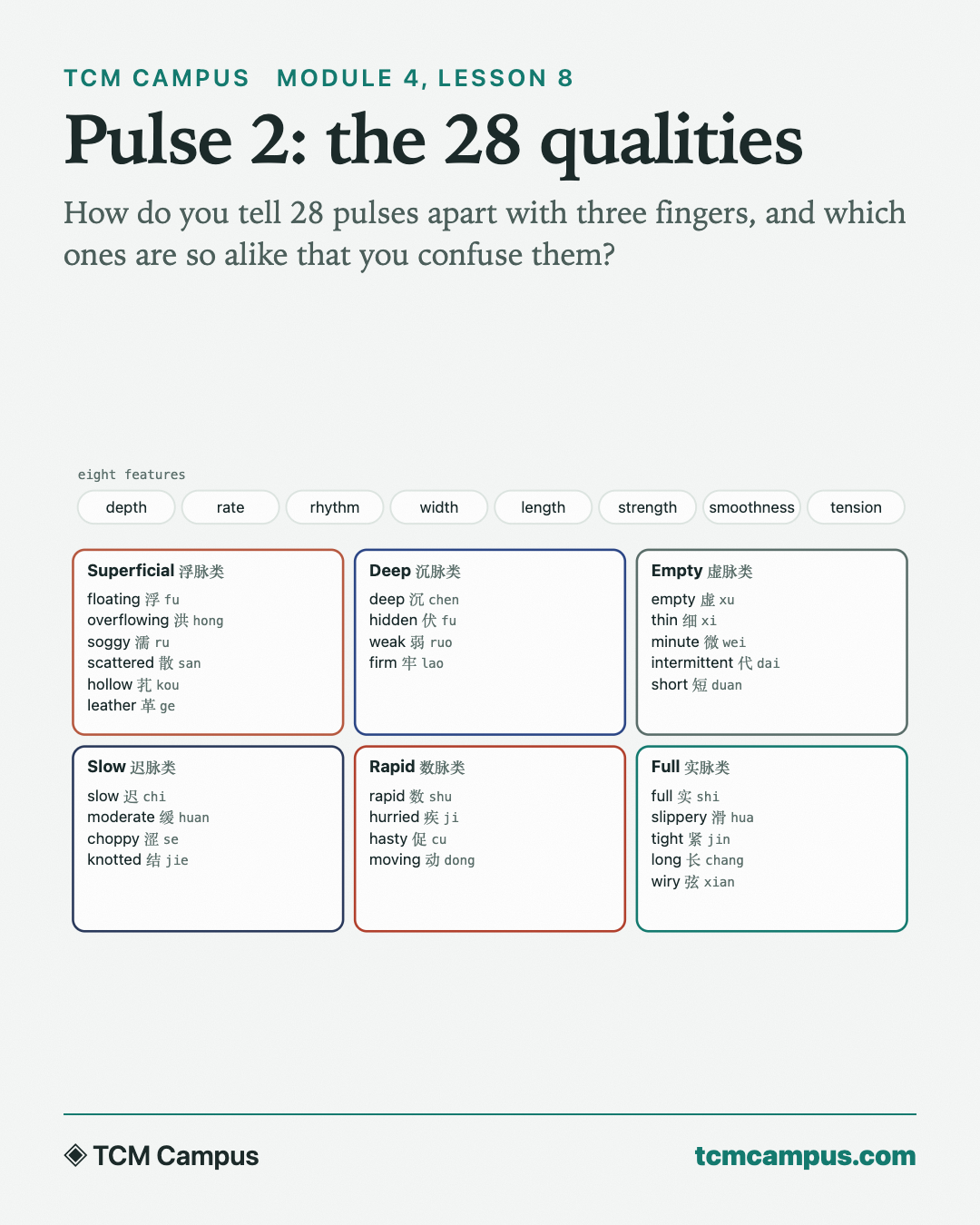
- Eight features. Depth, rate, rhythm, width, length, strength, smoothness, tension; mnemonic: where, how fast, how regular, how big, how strong, how it flows.
- Superficial and deep. Superficial: floating, overflowing, soggy, scattered, hollow, leather. Deep: deep, hidden, weak, firm; mnemonic: six float on top, four lie deep.
- Slow and rapid. Slow: slow, moderate, choppy, knotted. Rapid: rapid, hurried, hasty, moving; mnemonic: each rate has its stumble: a knot when slow, haste when fast.
- Empty and full. Empty: empty, thin, minute, intermittent, short. Full: full, slippery, tight, long, wiry.
- The three irregular ones. Hasty: rapid, stops irregularly. Knotted: slow, stops irregularly. Intermittent: stops at regular intervals, with a long pause; mnemonic: haste, knot, pause.
- The trickiest pairs. Wiry (taut string) versus tight (twisted rope); soggy (soft on top) versus weak (soft in the depth); hollow (scallion stalk) versus leather (drum skin); thin (a clear thread) versus minute (almost gone).
- Red flags. Any irregular pulse: ECG. Hurried, around 120 or more at rest: to the GP the same day. Hollow after blood loss, or minute, scattered or hidden in a sick patient: emergency.
The rest of this lesson is reference.
Three practice questions from this lesson
Superficial and broad, soft; you feel the edge, the middle is empty, like the stalk of a scallion.
- Leather
- Soggy
- Hollow
Answer: Hollow. Hollow: after major loss of Blood or fluids. Leather has a hard edge, soggy is thin without an empty middle.
Superficial, hard and taut, strikes against the finger; nothing in the depth.
- Leather
- Hollow
- Floating
Answer: Leather. Leather, the drum skin: loss of Essence or Blood. Hollow has a soft edge; floating is not hard and does not vanish in the depth, it only gets weaker.
Taut, and springs a little sideways against the finger, like a twisted rope.
- Long
- Wiry
- Tight
Answer: Tight. Tight: Cold, pain, retention of food. Wiry is straight and long and does not spring.
The rest of this lesson
In the course you get the step-by-step explanation, 17 case-based practice questions, 38 spaced-repetition flashcards, the pitfalls and the bridge to physiology with evidence grades. This lesson belongs to module 4: Diagnosis.