All lessons Module 2: Organs Lesson 8
Small Intestine and Large Intestine
What exactly does the Small Intestine separate, and why is the Large Intestine paired with the Lungs?
After this lesson you can name the functions of both intestines, follow the pure and the turbid to three exits, and read the stools as a mirror of five organs.
Know by heart
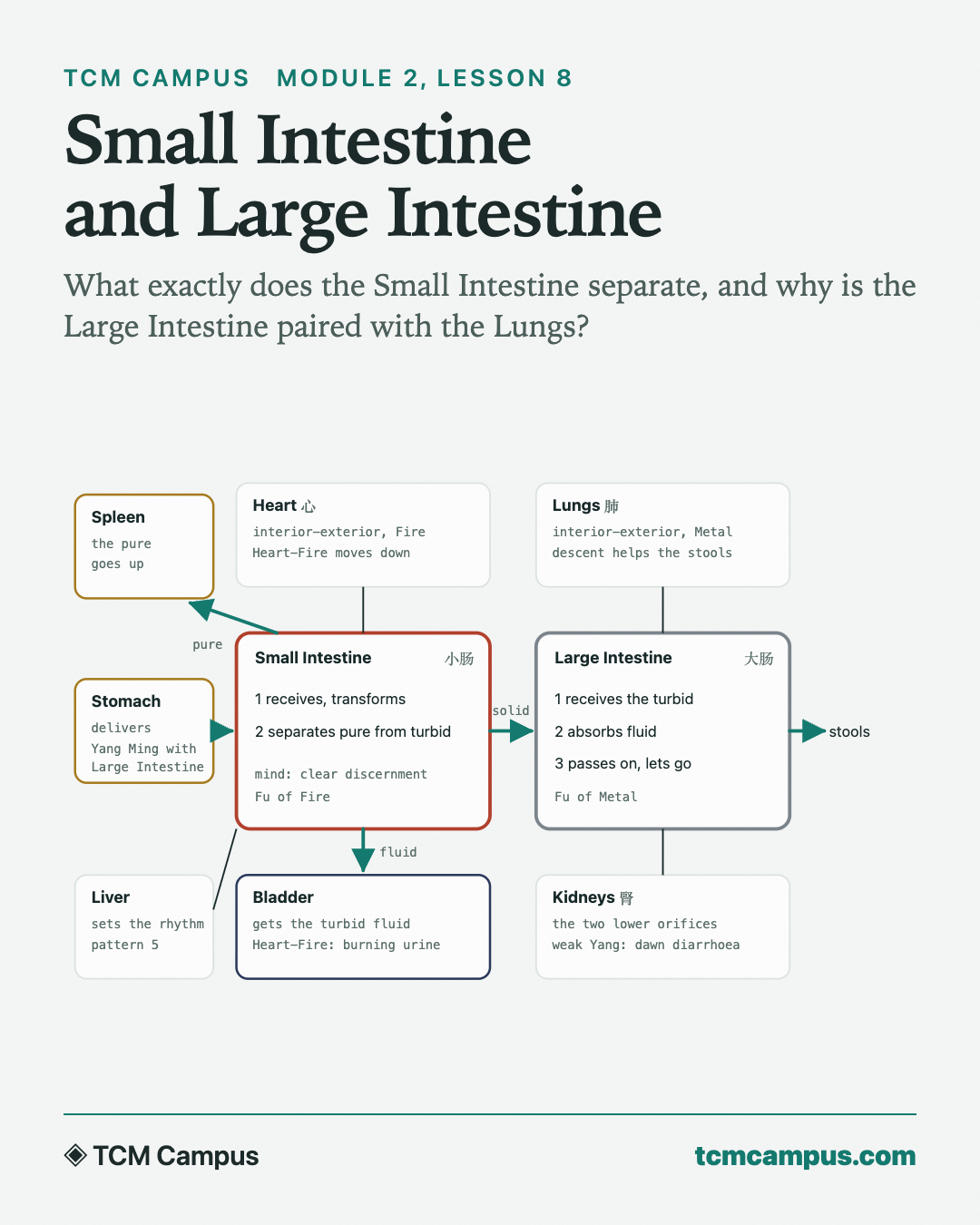
- Small Intestine, two functions. Receives and transforms; separates the fluids, the pure from the turbid. mnemonic: the sieve.
- One sieve, three exits. Pure up to the Spleen; turbid solid to the Large Intestine; turbid fluid to the Bladder.
- Large Intestine. Receives the turbid, absorbs fluid, forms the stools and passes them on. mnemonic: the wringer.
- Heart and Small Intestine. Fire; Heart-Fire moves down via the Small Intestine and Bladder: mouth ulcers and dark, burning urine (pattern 15). Mental aspect of the Small Intestine: clear discernment.
- Lungs and Large Intestine. Metal; descending Lung-Qi helps the stools, and a blocked bowel hampers the descending of the Lungs.
- Four other voices. Spleen: loose stools; Stomach: Yang Ming, Heat dries; Liver: alternating (pattern 5); Kidneys: the two lower orifices, diarrhoea at dawn. mnemonic: read the stools and you read five organs.
- Su Wen 8. Small Intestine: the official who receives and transforms; Large Intestine: the official of passing on (paraphrase).
The rest of this lesson is reference.
Three practice questions from this lesson
What are the two functions of the Small Intestine according to Maciocia ch. 14?
- Receiving and transforming; separating fluids
- Absorbing fluid; forming and passing on the stools
- Storing bile; the courage to decide
Answer: Receiving and transforming; separating fluids. Receiving and transforming, and separating the pure from the turbid. Absorbing fluid and passing on belong to the Large Intestine; bile and deciding to the Gall-Bladder.
Where does the turbid fluid part go?
- To the Bladder
- To the Large Intestine
- To the Spleen
Answer: To the Bladder. Pure to the Spleen, turbid solid to the Large Intestine, turbid fluid to the Bladder.
Why does Heart-Fire give burning urine?
- Via its partner the Small Intestine, to the Bladder
- The Heart controls the Bladder directly
- Via the Lungs, which let fluids descend to the Bladder
Answer: Via its partner the Small Intestine, to the Bladder. The interior-exterior pair plus the separating function: the Heart passes Heat to the Small Intestine, which separates the fluids off to the Bladder; that is how Heat from the Heart ends up in the urine (module 1, lesson 5, pattern 15). The Lungs let fluids descend to the Bladder but carry no Heart-Fire, and the Heart does not control the Bladder.
The rest of this lesson
In the course you get the step-by-step explanation, 14 case-based practice questions, 16 spaced-repetition flashcards, the pitfalls and the bridge to physiology with evidence grades. This lesson belongs to module 2: Organs.