All lessons Module 5: Patterns Lesson 9
The Spleen: all patterns
Weak, cold, sinking, leaking, dry or damp: which finding tells you which Spleen pattern it is, and does the Dampness come from inside or from outside?
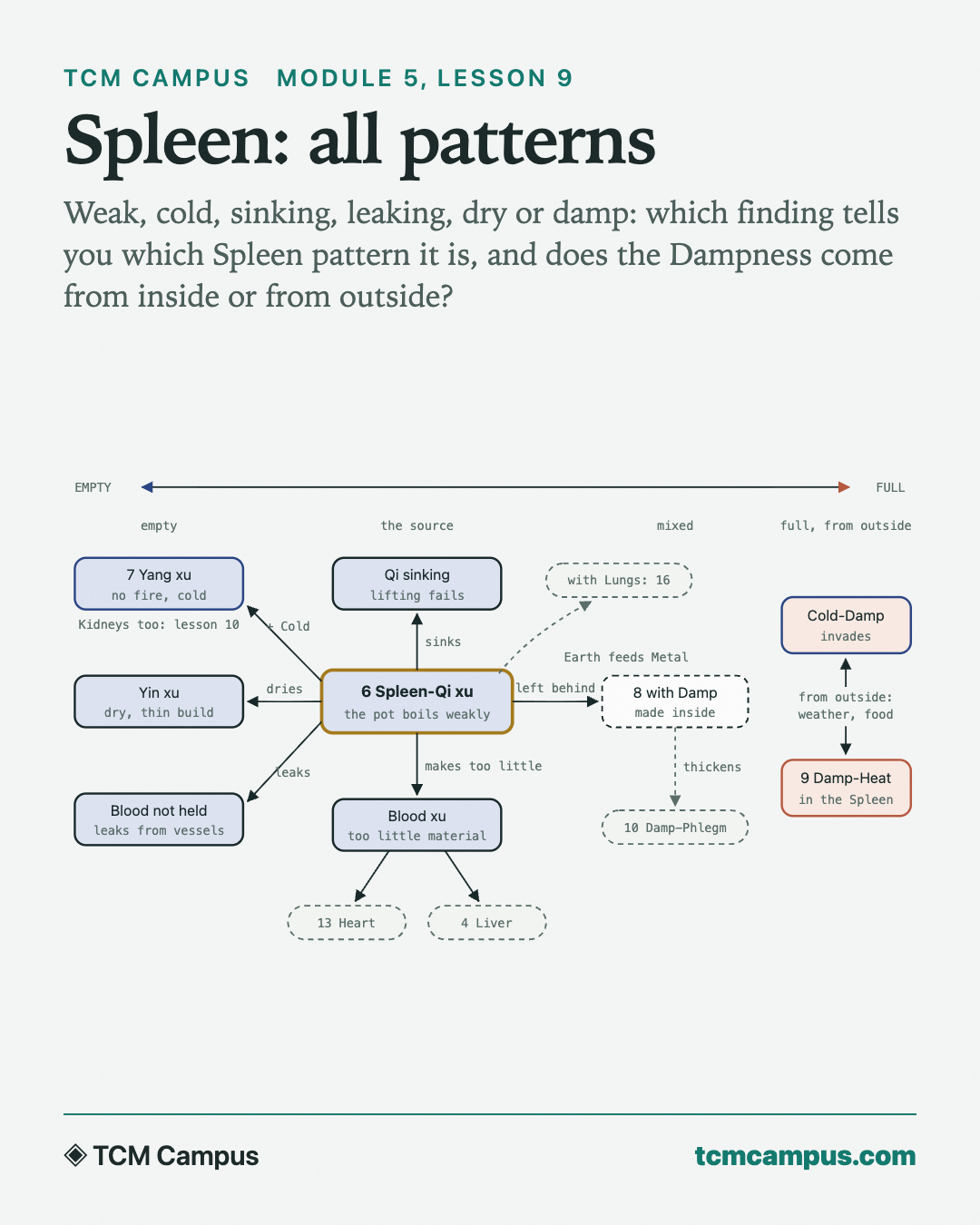
After this lesson you know all the Spleen patterns of ch. 36 with their signs, tongue, pulse, cause and principle; you can tell the six deficiencies apart, separate the Dampness the Spleen makes itself from the Dampness that invades, and see how an empty Spleen works through into the Heart, Lungs, Liver and Kidneys. Patterns 6 to 9 from module 1 stay exactly as they were; the rest builds on them.
Know by heart
- Six deficiencies. Qi (6), Yang (7), sinking, not holding Blood, Blood deficiency, Yin deficiency. mnemonic: weak, cold, sinks, leaks, pale, dry.
- The two core patterns (module 1). 6: tired and bloated after eating, loose stools; pale with teeth marks; empty; tonify Spleen-Qi. 7: add cold and watery stools; pale, wet, swollen; deep, weak, slow; warm Spleen-Yang.
- Sinks or leaks. Sinking: bearing-down feeling, prolapse, chronic diarrhoea; tonify and raise Spleen-Qi; Bu Zhong Yi Qi Tang. Not holding Blood: bruising, light seeping bleeding; tonify Spleen-Qi so that the Blood stays in the vessels; Gui Pi Tang.
- Dampness three ways. 8, made inside: swollen, sticky white; slippery or soggy. Cold-Damp, invading: thick sticky white, cold in the epigastrium; slippery and slow. 9 Damp-Heat: red, sticky yellow; slippery-rapid. mnemonic: made inside is empty and wet; invaded from outside is full, cold or hot.
- Blood and Yin. Blood deficiency: Spleen signs plus a dull pale complexion, scanty periods; pale and thin; tonify the Spleen, nourish Blood. Yin deficiency: dry mouth and lips, dry stools, thin build; little coating in the centre; nourish Spleen-Yin.
- Combined. With the Heart the Gui Pi picture (13); with the Lungs, Earth not nourishing Metal (16); with the Liver, Blood deficiency (4); with the Kidneys, Yang deficiency (lesson 10). mnemonic: the Spleen makes, the others show the shortfall.
- Five deciders. Cold: Yang. Bearing down: sinking. Bleeding: holding. Thick coating with a full pulse: Dampness from outside. Yellow coating: Heat.
The rest of this lesson is reference.
Three practice questions from this lesson
Case. Man, 34, back from a hot holiday with ice-cold drinks and a lot of fruit every day. For three days, fullness and oppression in the epigastrium, a cold feeling there that gets better with a hot-water bottle, heavy head, no thirst, loose stools. Tongue with a thick sticky white coating; pulse slippery and slow, forceful.
- 8 Spleen deficiency with Dampness
- 7 Spleen-Yang deficiency
- Cold-Damp invading the Spleen
Answer: Cold-Damp invading the Spleen. Sudden, after cold food, a thick coating and a forceful slippery, slow pulse: Cold-Damp invading the Spleen, an excess from outside. 8 is insidious with deficiency in front and a soggy pulse; 7 is chronically cold with a deep, weak pulse.
Case. Woman, 50, tired and heavy for years, sticky loose stools, slightly nauseous, no cold and no Heat. Tongue swollen with teeth marks and a thin sticky white coating; pulse soft, disappears under pressure.
- Cold-Damp invading the Spleen
- 8 Spleen deficiency with Dampness
- 9 Damp-Heat
Answer: 8 Spleen deficiency with Dampness. Insidious, deficiency in front, soggy pulse: the Spleen makes the Dampness itself. No cold and no thick coating: no invasion. No yellow coating or foul smell: no Heat.
Case. Woman, 55, three childbirths, works on her feet. A heavy, bearing-down feeling in the lower abdomen, worse in the evening, and the feeling that something is coming down. Tired, loose stools. What first?
- A month of Bu Zhong Yi Qi Tang first
- Warm Kidney-Yang first and see the GP afterwards
- A physical examination for prolapse first
Answer: A physical examination for prolapse first. The picture fits Spleen-Qi sinking, but a prolapse is mechanical and is examined first, via GP, gynaecologist or pelvic floor physiotherapist. Then the pattern: tonify and raise (Bu Zhong Yi Qi Tang). Tiredness, loose stools and sinking point to the Spleen, not the Kidneys.
The rest of this lesson
In the course you get the step-by-step explanation, 15 case-based practice questions, 21 spaced-repetition flashcards, the pitfalls and the bridge to physiology with evidence grades. This lesson belongs to module 5: Patterns.