All lessons Module 4: Diagnosis Lesson 5
The 16 questions, part 1
How do you ask about pain, food, stools, thirst, energy and the body so that the answer separates one pattern from another?
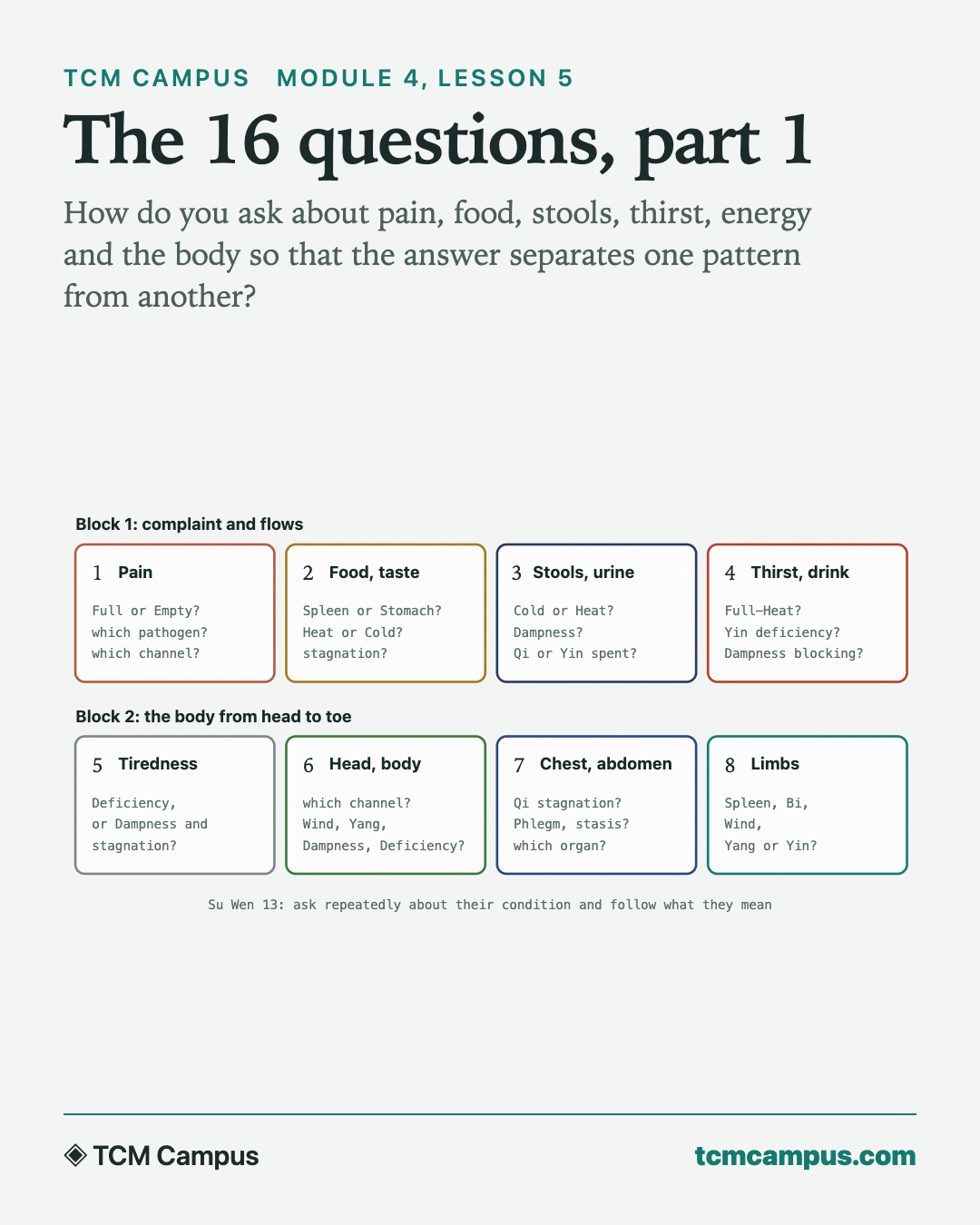
After this lesson you can work through questions 1 to 8 of the sixteen with the follow-up questions that make the difference, read pain by its character and by what influences it, place a headache on a channel, know why tiredness is not always Deficiency, and know the red flags for each question.
Know by heart
- Questions 1 to 8. Block 1, complaint and flows: pain; food and taste; stools and urine; thirst and drink. Block 2, the body from head to toe: tiredness; head, face and body; chest and abdomen; limbs; mnemonic: first what goes in and out, then from head to toe.
- Pain: six characters. Distending and pressing: Qi stagnation. Stabbing, fixed, worse at night: Blood stasis. Heavy: Dampness. Burning: Heat. Cramping and better with warmth: Cold. Dull and nagging: Deficiency; mnemonic (a later saying): where there is no flow, there is pain; where there is no nourishment, there is pain too.
- Pain: four follow-up questions. Pressure: better is Empty, worse is Full. Warmth or cold. Eating: better is Empty, worse is Full. Movement: better with movement is stagnation, better with rest is Deficiency.
- Headache by location. Forehead: Yangming (Stomach). Temples and sides: Shaoyang (Gall-Bladder). Occiput and neck: Taiyang (Bladder). Vertex: Jueyin (Liver); mnemonic: Yangming looks ahead, Shaoyang looks sideways, Taiyang looks back, Jueyin sits on top.
- Taste. Bitter: Heat in the Liver or Heart. Sweet and sticky: Spleen, Dampness. Sour: Liver and Stomach, or food retention. Salty: Kidneys. No taste: Spleen.
- Tiredness is not always Deficiency. Worse after exertion and better with rest: Deficiency. Heavy and worse in the morning: Dampness or Phlegm. Better with movement and distraction, changing with mood: Liver-Qi stagnation (textbook knowledge).
- Red flags, part 1. Chest pain on exertion; a sudden, very severe headache; unintended weight loss; blood in the stools, vomit or urine; difficulty swallowing; diarrhoea at night; great thirst with a lot of urination; sudden loss of strength in an arm or leg.
The rest of this lesson is reference.
Three practice questions from this lesson
Which four questions form the first block, complaint and flows?
- Tiredness; head, face and body; chest and abdomen; limbs
- Pain; food and taste; stools and urine; thirst and drink
- Sleep; sweating; ears and eyes; cold and heat
Answer: Pain; food and taste; stools and urine; thirst and drink. Block 1 is about the complaint and what goes in and out; block 2 is the body from head to toe; block 3 the night and the regulators (lesson 6).
A distending, pressing pain in the hypochondrium that changes with mood and improves with movement.
- Qi stagnation
- Blood stasis
- Qi deficiency
Answer: Qi stagnation. Distension that changes with mood and improves with movement: the Qi is stuck (pattern 1).
A fixed, stabbing pain in one place that is worse at night and cannot bear pressure.
- Empty-Heat
- Blood stasis
- Dampness
Answer: Blood stasis. Fixed, stabbing, worse at night, worse with pressure: Blood stasis (pattern 18). In the chest: see a doctor first.
The rest of this lesson
In the course you get the step-by-step explanation, 17 case-based practice questions, 23 spaced-repetition flashcards, the pitfalls and the bridge to physiology with evidence grades. This lesson belongs to module 4: Diagnosis.