All lessons Module 2: Organs Lesson 11
The Extraordinary Yang organs and the Four Seas
Why does TCM mention the uterus, the brain and the bones in the same breath, and what do the Kidneys have to do with it?
After this lesson you can name the six Extraordinary Fu and say why they are extraordinary, say what nourishes the Uterus, follow the line from Jing via Marrow to brain and bones, and know the Four Seas in excess and deficiency. In module 1, lesson 5 you only had to recognise them.
Know by heart
- The six. Brain, Marrow, Bones, Blood Vessels, Gall-Bladder, Uterus. mnemonic: three of the marrow, two for a pure fluid, one for the child.
- Why extraordinary. The form of a Fu (hollow), the work of a Zang (storing, not passing on); Su Wen 11. mnemonic: a tube that behaves like a vessel.
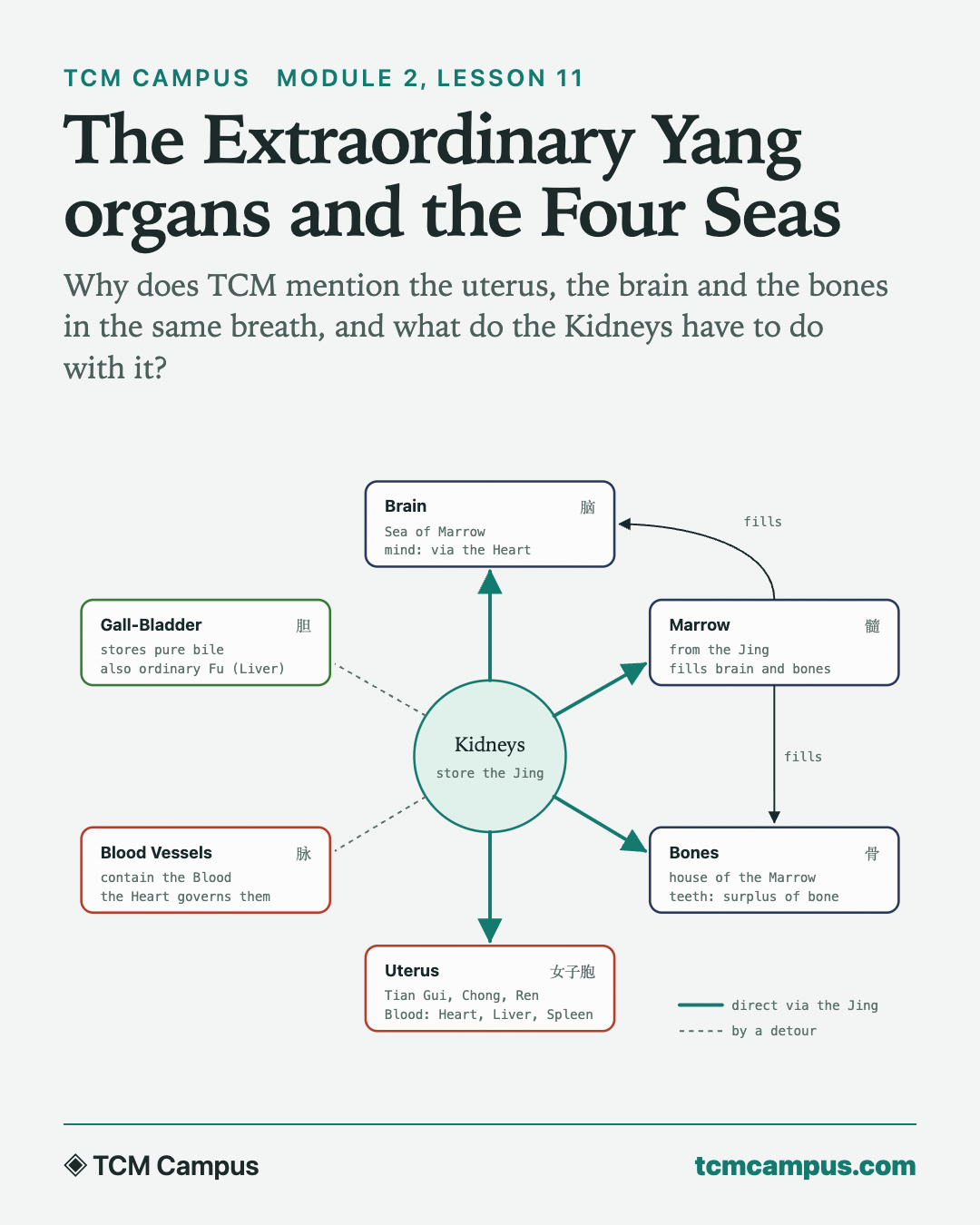
- What nourishes the Uterus. The Kidneys (Jing, Tian Gui), the Chong (Blood) and Ren (Yin), the Heart (Bao Mai), the Liver and Spleen (Blood). mnemonic: one root, two vessels, a thread to the Heart, Blood from two sides.
- Seven and eight. Su Wen 1: in women Tian Gui arrives at 14 and is exhausted at 49; in men it arrives at 16 and is exhausted at 56.
- Jing, Marrow, Brain, Bones. Jing produces Marrow; Marrow fills the spinal cord and brain (the Sea of Marrow) and the bones (the house of the Marrow). Thinking and consciousness are housed by the Heart.
- Blood Vessels and Gall-Bladder. The vessels contain the Blood, and the Heart governs them. The Gall-Bladder stores pure bile and receives no food: a Fu and Extraordinary at the same time.
- Four Seas (Ling Shu 33). Marrow (brain), Blood (Chong Mai), Qi (chest), Water and Grain (Stomach); each with a picture in excess and in deficiency. mnemonic: head, Chong, chest, belly.
The rest of this lesson is reference.
Three practice questions from this lesson
Why are these six organs called extraordinary?
- Hollow like a Fu, but they store like a Zang
- They all lie below the navel
- They all have their own channel and a partner
Answer: Hollow like a Fu, but they store like a Zang. Su Wen 11 (paraphrase): they store and do not release. Apart from the Gall-Bladder they have no partner and no channel of their own.
Which one is not an Extraordinary Fu?
- Marrow
- Stomach
- Blood Vessels
Answer: Stomach. The Stomach is an ordinary Fu. The six: Brain, Marrow, Bones, Blood Vessels, Gall-Bladder, Uterus.
Which organ appears on both lists, and why is it extraordinary?
- Gall-Bladder: pure bile, no food
- Small Intestine: separates pure from turbid
- Uterus: stores Blood and the foetus
Answer: Gall-Bladder: pure bile, no food. The Gall-Bladder is the Fu of the Liver and at the same time Extraordinary: it stores pure bile and receives no food (ch. 19 p. 243). The Uterus is only Extraordinary, the Small Intestine only an ordinary Fu.
The rest of this lesson
In the course you get the step-by-step explanation, 13 case-based practice questions, 17 spaced-repetition flashcards, the pitfalls and the bridge to physiology with evidence grades. This lesson belongs to module 2: Organs.