All lessons Module 6: Points Lesson 1
The Five Shu points, in depth
Why do so many powerful points lie between fingertip and elbow, and how do you choose between the five?
After this lesson you know the movement of Qi along the five points (Ling Shu 1), their classical indications (Nan Jing 68 and Ling Shu 44), the element of each point (Nan Jing 64) with the rules for tonifying and sedating (Nan Jing 69 and 75), the lower He-Sea points of the Fu (Ling Shu 4), and all sixty Shu points with their name and key action. No location, no needling technique.
Know by heart
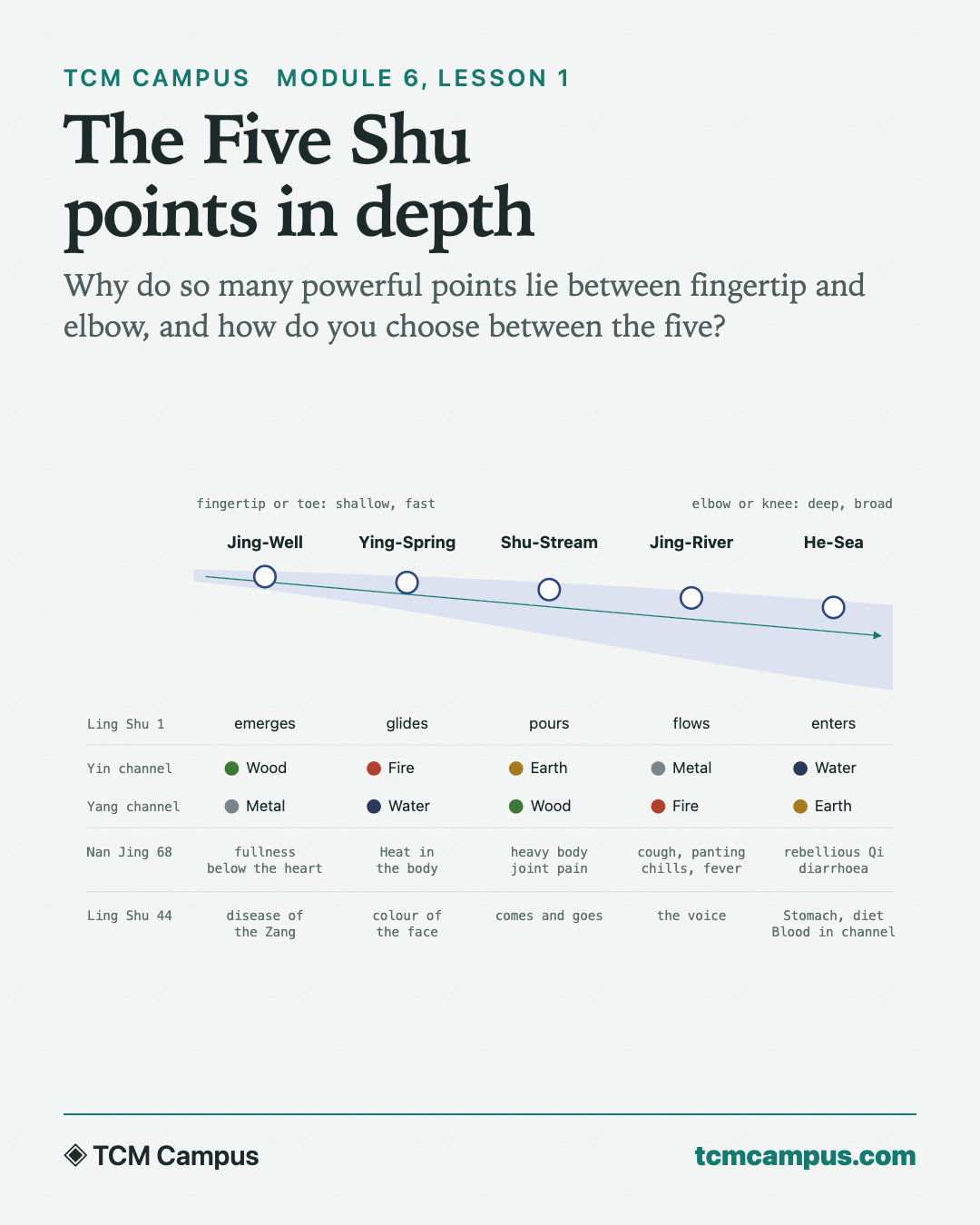
- The river (Ling Shu 1). Jing-Well: Qi emerges. Ying-Spring: it glides. Shu-Stream: it pours. Jing-River: it flows. He-Sea: it enters. mnemonic: well, spring, stream, river, sea: the water gets deeper at every point.
- Nan Jing 68. Jing-Well: fullness below the heart. Ying-Spring: Heat in the body. Shu-Stream: heavy body and painful joints. Jing-River: cough, panting, chills and fever. He-Sea: rebellious Qi and diarrhoea. mnemonic: five H's: heart, heat, heavy, hacking cough, heaving Qi.
- Ling Shu 44. Jing-Well: disease of the Zang. Ying-Spring: changed facial colour. Shu-Stream: complaints that come and go. Jing-River: the voice. He-Sea: Stomach, diet and Blood in the channel.
- Elements (Nan Jing 64). Yin channels start with Wood, Yang channels with Metal; after that the generating sequence. mnemonic: Yang starts with the element that controls the Yin one: Metal over Wood.
- Tonifying and sedating (Nan Jing 69). The point of the mother element tonifies, that of the child element sedates: Lungs LU-9 and LU-5; Liver LR-8 and LR-2; Kidneys KI-7 and KI-1; Heart HT-9 and HT-7. mnemonic: tonify with the element before your own, sedate with the one after.
- Lower He-Sea (Ling Shu 4). ST-36 Stomach, ST-37 Large Intestine, ST-39 Small Intestine, BL-40 Bladder, BL-39 Triple Burner, GB-34 Gall-Bladder; the He-Sea treats the internal Fu.
- Key points by Shu category. Shu-Stream: LU-9, LR-3, HT-7, KI-3 (all four also Yuan) and SI-3. Jing-River: BL-60. He-Sea: ST-36, LI-11, GB-34, SP-9, BL-40.
The rest of this lesson is reference.
Three practice questions from this lesson
Ling Shu 1: where does Qi 'pour'?
- Jing-Well
- Ying-Spring
- Shu-Stream
Answer: Shu-Stream. Emerges, glides, pours, flows, enters: Jing-Well, Ying-Spring, Shu-Stream, Jing-River, He-Sea.
According to Nan Jing 68, the Jing-River point is for ...
- cough, panting, chills and fever
- rebellious Qi and diarrhoea
- Heat in the body
Answer: cough, panting, chills and fever. Heat is Ying-Spring, rebellious Qi and diarrhoea He-Sea.
According to Ling Shu 44, for a disease that shows itself in the voice you choose ...
- the Ying-Spring point
- the Jing-Well point
- the Jing-River point
Answer: the Jing-River point. Zang: Jing-Well; colour: Ying-Spring; comes and goes: Shu-Stream; voice: Jing-River; Stomach and diet: He-Sea.
The rest of this lesson
In the course you get the step-by-step explanation, 16 case-based practice questions, 20 spaced-repetition flashcards, the pitfalls and the bridge to physiology with evidence grades. This lesson belongs to module 6: Points.