All lessons Module 1: Foundations Lesson 10
The four examinations
What do you need to see, hear, ask and feel before you may name a pattern?
After this lesson you know what each examination gathers, you know Maciocia's 16 questions, you can pick the question that separates two hypotheses, and you know which examination is the most repeatable.
Know by heart
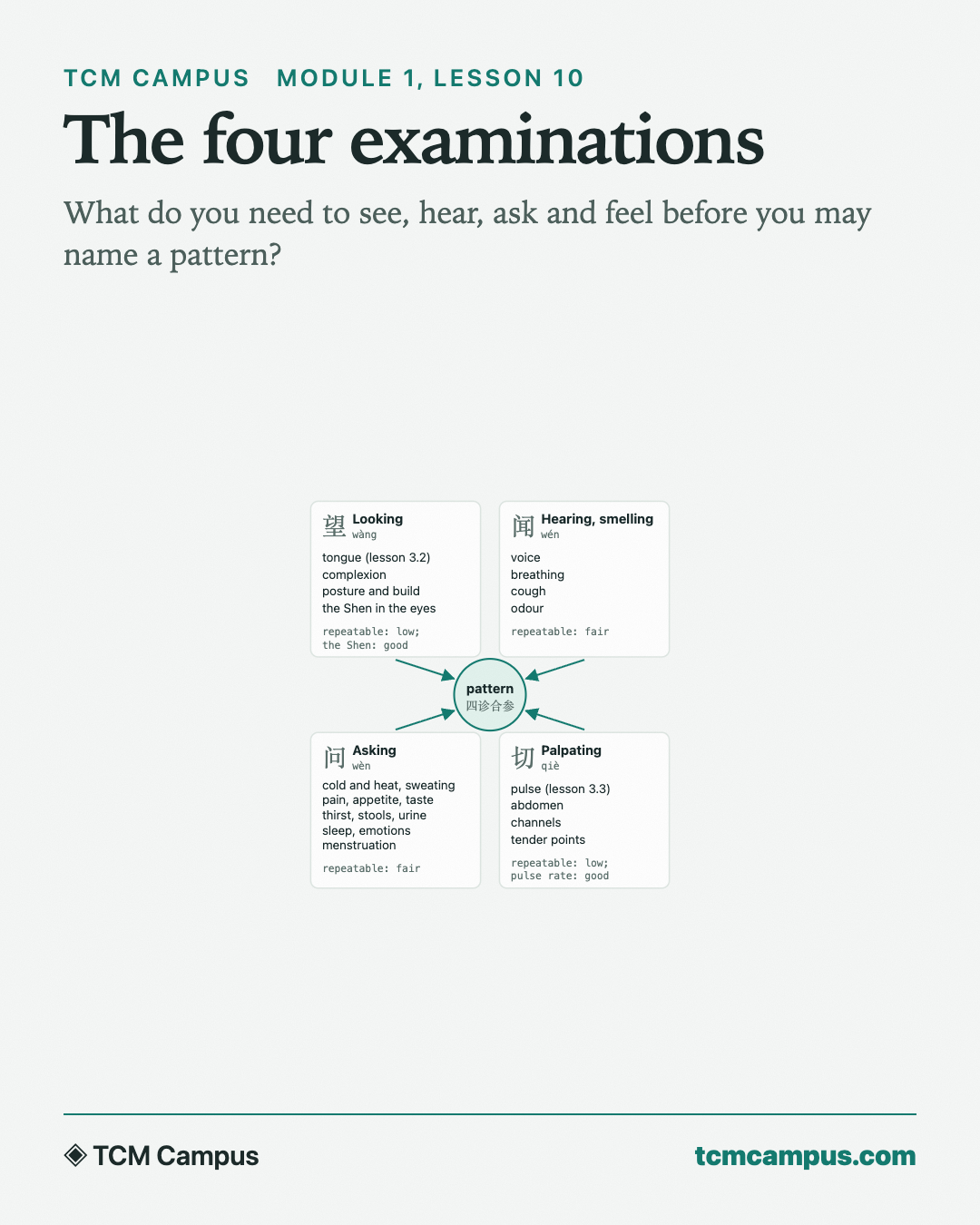
- The four examinations. Looking (望 wàng), hearing and smelling (闻 wén), asking (问 wèn), palpating (切 qiè); mnemonic: wen twice; 闻 has an ear (耳) in the door and hears and smells, 问 has a mouth (口) in the door and asks.
- Maciocia's 16 questions, in four blocks of four. Complaint and flows: pain, food and taste, stools and urine, thirst and drink. The body from top to bottom: tiredness, head and face, chest and abdomen, limbs. Night and regulators: sleep, sweating, ears and eyes, cold and heat. The person: emotions, sexuality, women, children; mnemonic: first what goes in and out, then the body from head to toe, then the night and the thermostat, then the person.
- The classical ten (shi wen ge). Cold and heat, sweating, head and body, stools and urine, food and drink, chest, hearing, thirst, past illnesses, cause; plus medicines and menstruation; mnemonic: from outside to inside, from the skin (cold, sweat) via the body to the history (past, cause).
- What Maciocia adds for Western patients. Tiredness, emotions, sexuality; and limbs as a question of its own; mnemonic: the Western SET, Sexuality, Emotions, Tiredness.
- From broad to narrow. Presenting question and flags, story, net, looking and feeling, two or three hypotheses, separating questions, weighing together; mnemonic: cast the net, then ask only questions whose answer differs per hypothesis.
- Repeatability. Asking and listening better than looking and palpating; exceptions the Shen and the pulse rate (Hua 2012, O'Brien 2009); mnemonic: what the patient says can be repeated, what you see and feel cannot, except the eyes and the beat count.
- Red flags in the history. Unintended weight loss, blood loss, neurological deficit, unexplained fever, chest pain, a sudden very severe headache, thoughts of death; with one yes, refer first.
The rest of this lesson is reference.
Three practice questions from this lesson
Case 1. Woman, 36, irritable for months, a feeling of tension under the ribs, sighs a lot; worse with stress. Liver-Qi stagnation or Liver-Fire?
- Do you have a bitter taste, thirst, hard stools or red eyes?
- Do the complaints get worse with stress, anger or frustration?
- Do you sigh often, and do you feel tension or distension under the ribs?
Answer: Do you have a bitter taste, thirst, hard stools or red eyes?. Liver-Fire is stagnation that has turned into Heat: outbursts of anger, red eyes and face, bitter taste, thirst, constipation, and a red tongue with a yellow coating (patterns 1 and 2). The other two ask about what both share and what you already know; the answer is yes for both.
Case 2. Man, 55, tired, weak lower back and knees. Kidney-Yin deficiency or Kidney-Yang deficiency?
- Do you tend to feel warm or cold, how do your soles feel, and do you pass urine at night?
- Are your lower back and knees weak, and do you tire easily by the end of the day?
- How is your appetite, and do you feel bloated or heavy after eating?
Answer: Do you tend to feel warm or cold, how do your soles feel, and do you pass urine at night?. They share the organ, not the nature. Weak lower back and knees and tiredness you already know; appetite and bloating are about the Spleen. Yin deficiency: hot palms and soles, night sweating, dry mouth at night. Yang deficiency: cold lower back, feels the cold, nocturia with clear urine (patterns 11 and 12). So ask about Cold and Heat, not about yet another Kidney complaint.
Case 3. Man, 28, has had a cold with a headache since yesterday; pulse floating. Wind-Cold or Wind-Heat?
- Since when have you been ill, and did it start suddenly, from one day to the next?
- What dominates, chills or fever, and do you have a sore throat or a stiff neck?
- Do you feel flu-like, and has your head hurt since the cold began?
Answer: What dominates, chills or fever, and do you have a sore throat or a stiff neck?. Cold: chills more than fever, stiff neck, clear nasal discharge, pulse floating and tight. Heat: fever more than chills, sore throat, thirst, pulse floating and rapid (pattern 17). Both are acute, flu-like and can come with a headache.
The rest of this lesson
In the course you get the step-by-step explanation, 15 case-based practice questions, 24 spaced-repetition flashcards, the pitfalls and the bridge to physiology with evidence grades. This lesson belongs to module 1: Foundations.