All lessons Module 1: Foundations Lesson 5
The Zang-Fu
If the Liver is not the liver, then what is it?
After this lesson you can name, for each organ, its functions, sense organ, tissue, emotion, spiritual aspect and Fu partner; explain the San Jiao in three images; and recognise the five axes along which organs pull each other along. That is the grammar beneath the nineteen patterns of the coming lessons.
Know by heart
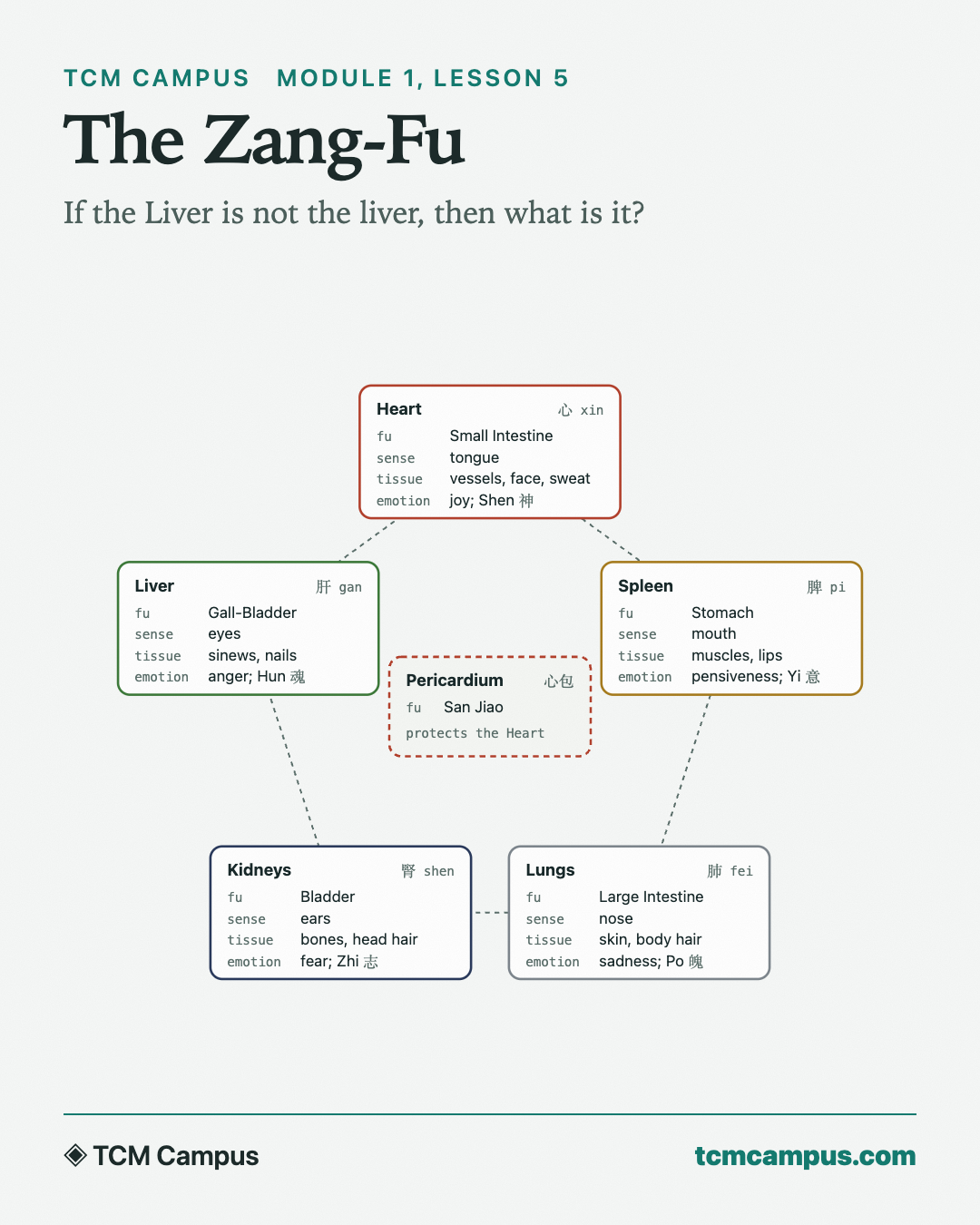
- Five pairs, plus one. Liver and Gall-Bladder, Heart and Small Intestine, Spleen and Stomach, Lungs and Large Intestine, Kidneys and Bladder; Pericardium and San Jiao. mnemonic: the two organs in the chest get the two intestines, the Heart the small one, the Lungs the large one.
- Sense organs and tissues. Liver eyes and sinews; Heart tongue and vessels; Spleen mouth and muscles; Lungs nose and skin; Kidneys ears and bones. mnemonic: the Liver looks, the Heart speaks, the Spleen eats, the Lungs breathe, the Kidneys listen.
- Emotion and spiritual aspect. Anger and Hun (Liver), joy and Shen (Heart), pensiveness and Yi (Spleen), sadness and Po (Lungs), fear and Zhi (Kidneys). mnemonic: Hun and Po are the two souls, Ethereal for the Liver and Corporeal for the Lungs; Yi, the Intellect, digests ideas as the Spleen digests food; Zhi is the Will-Power, deep as the root.
- Core functions per Zang. The six cards in step 3. mnemonic: director, emperor, kitchen and lift, lid, root, bodyguard.
- Zang versus Fu. Zang store and do not release (Yin, full); Fu receive, pass on and empty themselves (Yang, hollow). mnemonic: a jar and a pipe.
- San Jiao. Not an organ but a function: passage for Yuan Qi, coordination of fluid metabolism. Upper a mist (Heart, Lungs), middle a bubbling cauldron (Spleen, Stomach), lower a drainage ditch (Kidneys, Bladder, intestines). mnemonic: the steam, the pan, the sink.
- Five axes. Liver and Spleen (free flow versus transformation); Heart and Kidneys (Fire and Water, Shen and Jing); Lungs and Kidneys (the Kidneys receive Qi); Spleen and Kidneys (Yang; Post-Heaven and Pre-Heaven); Heart and Spleen (Blood). mnemonic: the Kidneys sit in three of the five, as the root of Water, Qi and Yang.
The rest of this lesson is reference.
Three practice questions from this lesson
A practitioner says: 'your Liver is not storing the Blood properly'. Which complaints go with that?
- Nocturia, cold lower back and knees, swollen ankles
- Cough, breathlessness, spontaneous sweating, frequent colds
- Blurred vision, dry eyes, cramps, scanty periods
Answer: Blurred vision, dry eyes, cramps, scanty periods. Storing Blood, with the eyes as sense organ and the sinews and nails as tissue: Liver-Blood deficiency (pattern 4). The other two are the Lungs (16) and the Kidneys (12).
Which organ receives Qi?
- Spleen
- Lungs
- Kidneys
Answer: Kidneys. The Kidneys receive the Qi that the Lungs send down: the Lungs and Kidneys axis.
Which organ makes Qi rise and keeps the Blood in the vessels?
- Liver
- Spleen
- Heart
Answer: Spleen. Both are the Spleen. If raising fails: Spleen-Qi sinking; if holding fails: Spleen not controlling Blood.
The rest of this lesson
In the course you get the step-by-step explanation, 17 case-based practice questions, 35 spaced-repetition flashcards, the pitfalls and the bridge to physiology with evidence grades. This lesson belongs to module 1: Foundations.