All lessons Module 4: Diagnosis Lesson 3
Tongue 1: colour and shape
What does the tongue body itself say, apart from the coating, and when does it weigh more?
After this lesson you can recognise six tongue-body colours with their variants, read size, shape and movement, interpret cracks, points and teeth marks, know which tongue pictures need a doctor first, and how reliably tongue colour is seen.
Know by heart
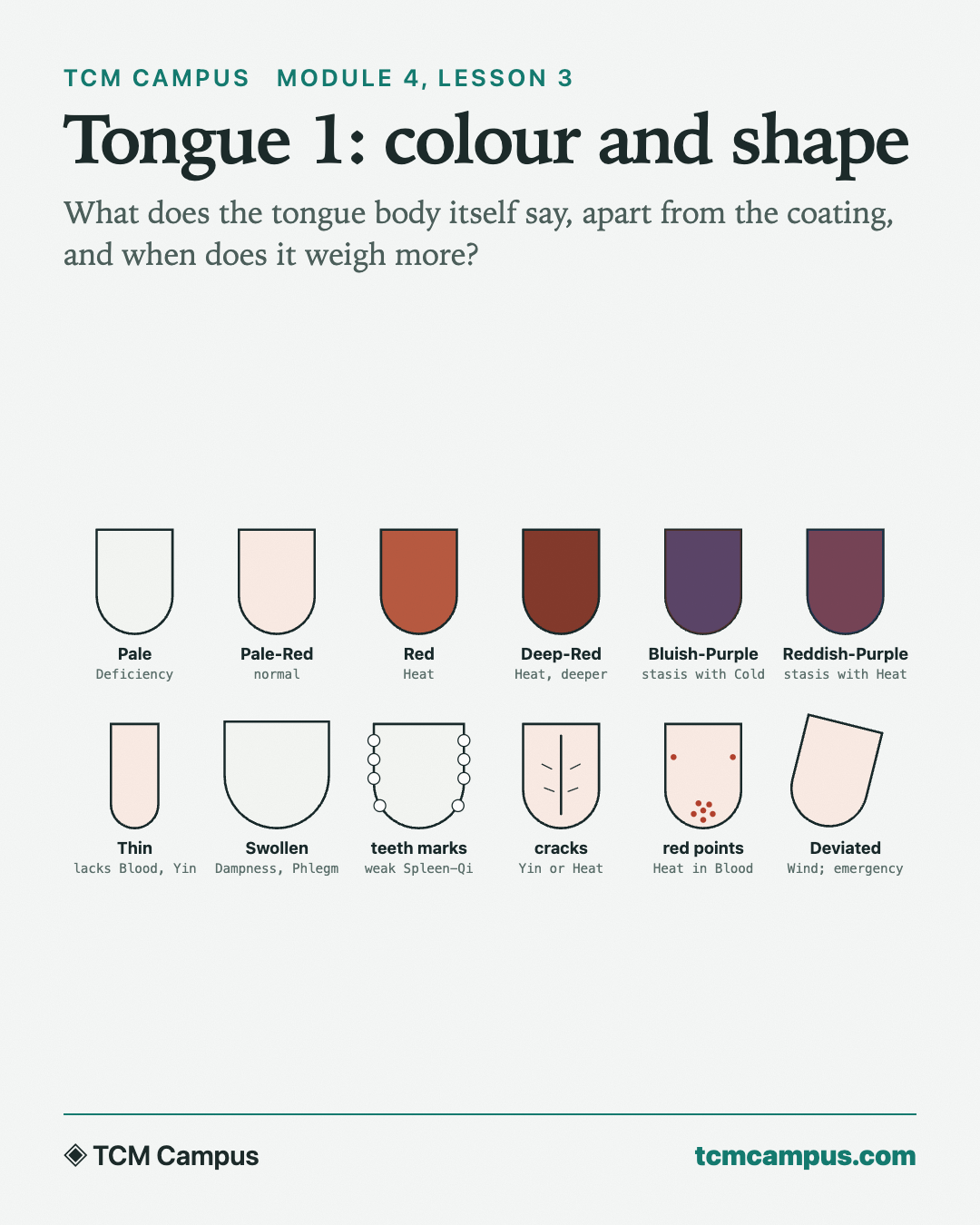
- Body first. First the colour, then the shape. The body shows Qi, Blood, Yin and Yang and changes slowly, over weeks; if it contradicts the coating, the body weighs more (textbook knowledge).
- Six colours. Pale-Red normal. Pale Deficiency: slightly dry Blood, wet Yang. Red Heat: with coating Full, without Empty. Deep-Red: Heat that sits deeper and lasts longer. Purple Blood stasis: bluish with Cold, reddish with Heat. Blue: severe Cold or stasis; mnemonic: from light to dark, empty, healthy, hot, hotter, still.
- Red in one place. Tip Heart, sides Liver and Gall-Bladder, centre Stomach. Red points: Heat in the Blood. Purple spots: stasis in that place.
- Size. Thin is too little (Pale Blood, Red Yin). Swollen is too much (Dampness or Phlegm; Pale Yang deficiency, Red Heat). Teeth marks: Spleen-Qi deficiency; mnemonic: thin is too little, swollen is too much, teeth marks are a Spleen that cannot hold the shape.
- Movement. Stiff, Flaccid, Quivering, Deviated or Short: Wind or severe Deficiency. Stiff or Deviated: rule out a stroke first.
- Cracks (textbook knowledge). Yin deficiency or Heat. Long in the midline reaching the tip: Heart. In the centre: Stomach. Short and transverse on the sides: Spleen. Lifelong cracks without complaints say little.
- Red flag. Suddenly swollen; Deviated or Stiff with speech problems; blue with breathlessness; smooth, red and burning (have bloods taken); a sore after three weeks; a tongue that fibrillates at rest with swallowing problems.
The rest of this lesson is reference.
Three practice questions from this lesson
Pale and wet, somewhat Swollen, versus Pale and slightly dry.
- Both Qi deficiency: slightly Pale
- Wet: Yang deficiency; slightly dry: Blood deficiency
- Wet and Swollen: Blood deficiency; slightly dry: Yang deficiency
Answer: Wet: Yang deficiency; slightly dry: Blood deficiency. In Yang deficiency the fluids are not transformed (wet, Swollen); in Blood deficiency the substance is missing (slightly dry, often Thin). Qi deficiency gives a slightly Pale tongue, without that difference in moisture.
A Red tongue. What decides whether it is Full-Heat or Empty-Heat?
- The shape: Swollen is Full, Thin is Empty
- The coating: with coating Full, without Empty
- Nothing; Red is always Full-Heat
Answer: The coating: with coating Full, without Empty. The colour says Heat; the coating says whether a pathogen is present: with coating Full, without or with little coating Empty. A Thin shape does point to Yin deficiency, but the quickest distinction is the coating (module 1, lesson 11).
Purple tongue with a bluish undertone, cold hands, cramping period pain that improves with warmth.
- Blood stasis with Cold
- Blood stasis with Heat
- Blood deficiency
Answer: Blood stasis with Cold. Purple is stasis; bluish and better with warmth is Cold bringing the Blood to a standstill. Reddish-Purple belongs to stasis with Heat.
The rest of this lesson
In the course you get the step-by-step explanation, 14 case-based practice questions, 19 spaced-repetition flashcards, the pitfalls and the bridge to physiology with evidence grades. This lesson belongs to module 4: Diagnosis.