All lessons Module 7: Treatment Lesson 2
Tonify or expel; acupuncture versus herbs
Do you tonify first, expel first or do both, and is the needle or the herb the better means for it?
After this lesson you can link Deficiency and Excess to tonifying and expelling, choose one of three orders in a mixed pattern, name the eight methods of herbal medicine with their limits, and say where, according to textbook knowledge, the needle is strong and where the herb.
Know by heart
- Tonify or expel. Deficiency you tonify (bu), Excess you drain (xie). Su Wen 74: the weak you tonify, the strong you drain. Ling Shu 10: full, drain; empty, tonify; sunken, moxa.
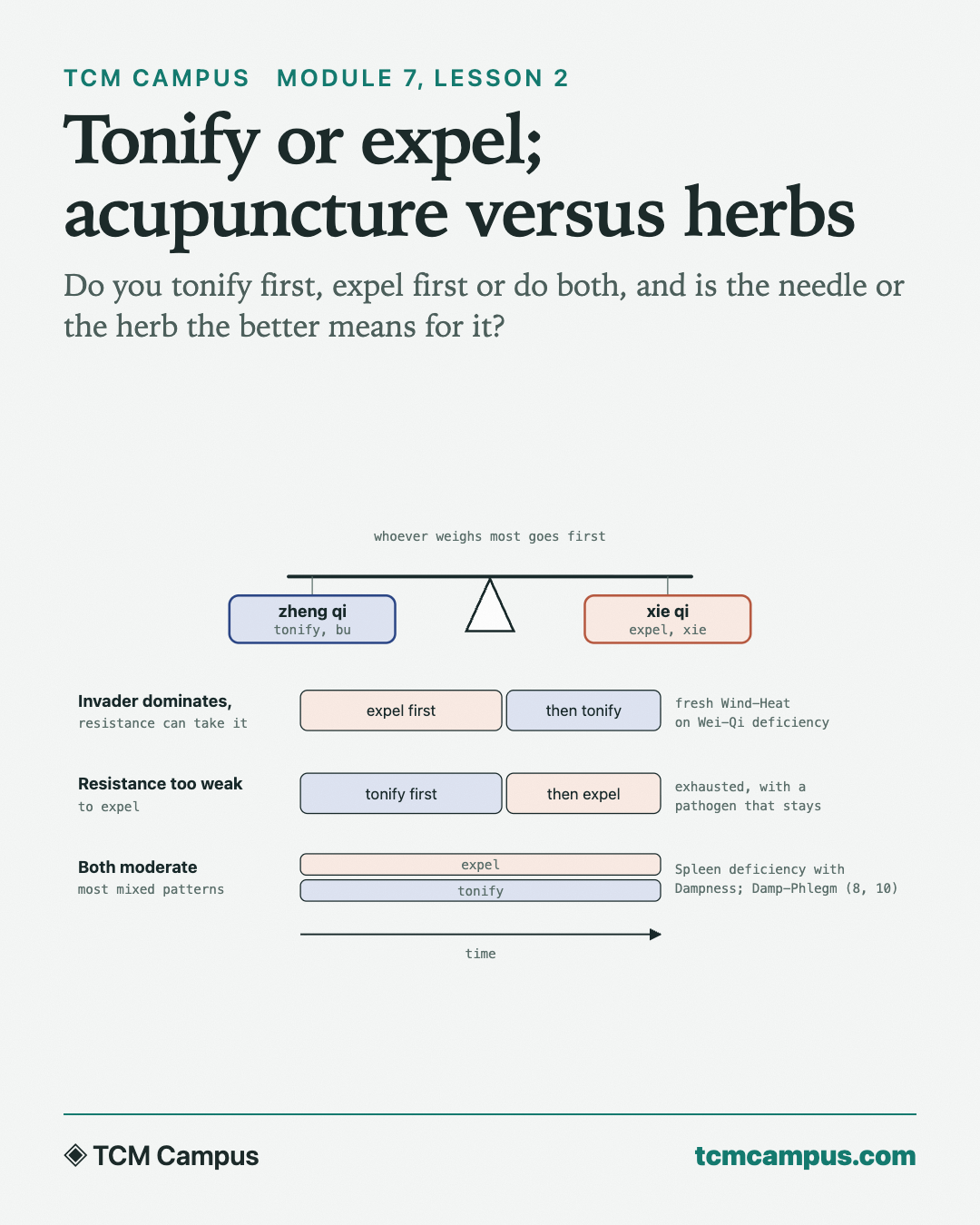
- Four situations. Strong without an invader: nothing to treat. Strong with an invader: expel. Weak without an invader: tonify. Weak with an invader: both, in an order.
- Three orders (textbook knowledge). Resistance too weak: tonify first. Invader dominates and the resistance can take it: expel first. Both moderate: at the same time. mnemonic: whoever weighs most goes first.
- Two mistakes. Tonifying with the thief inside (闭门留寇, textbook knowledge); expelling in exhaustion, which uses up what is left.
- Excess from Deficiency. Dampness, Phlegm, stagnation and stasis are xie qi the body makes itself; the principle then names both: "tonify the Spleen, resolve Dampness".
- Needle or herb (textbook knowledge). The needle moves, regulates and calms, acts on channel and pain, and fast; the herb nourishes Blood and Yin, warms and builds up over weeks. Often together: the needle for the branch, the herb for the root.
- Eight methods (Cheng Zhongling, 1732). Sweating, vomiting, purging, harmonising, warming, clearing, digesting, tonifying. mnemonic: three out (sweating, vomiting, purging), one in the middle (harmonising), four that adjust.
The rest of this lesson is reference.
Three practice questions from this lesson
Su Wen 74 gives a basic rule for the direction. Which one?
- Acute: the branch; chronic: the root
- Tonify the mother, drain the child
- The weak you tonify, the strong you drain
Answer: The weak you tonify, the strong you drain. Su Wen 74: 衰者补之,强者泻之. Ling Shu 10 says the same for each channel, with moxa for what has sunk. Mother and child is the rule of Nan Jing 69; acute the branch, chronic the root is the rule of root and branch.
Zheng qi weak, no pathogen. Which direction?
- Both at once
- Expel
- Tonify
Answer: Tonify. There is nothing to expel; expelling would use up what is left.
Case. Man, 30, fit, since yesterday a high fever more than chills, sore throat, thirst; pulse floating and rapid. Which order?
- Expel and tonify together
- Expel first: release the Exterior, clear Heat
- Tonify first, because fever exhausts
Answer: Expel first: release the Exterior, clear Heat. Strong with an invader: expel. The pathogen dominates and the resistance can take it. Tonifying, even alongside, closes the door with the thief inside. Rule out first: drowsiness, neck stiffness, breathlessness.
The rest of this lesson
In the course you get the step-by-step explanation, 16 case-based practice questions, 15 spaced-repetition flashcards, the pitfalls and the bridge to physiology with evidence grades. This lesson belongs to module 7: Treatment.