All lessons Module 7: Treatment Lesson 6
Treatment plans: Heart, Lungs and Kidneys
How do you turn a Heart, Lung or Kidney pattern into a point selection you can defend point by point?
After this lesson you know the fixed building blocks for each organ (Yuan, Luo, Xi-Cleft, Back-Shu, Front-Mu), you can build an example point selection with a reason for each point for the main Heart, Lung and Kidney patterns, and you know where moxa belongs and where it does not.
Know by heart
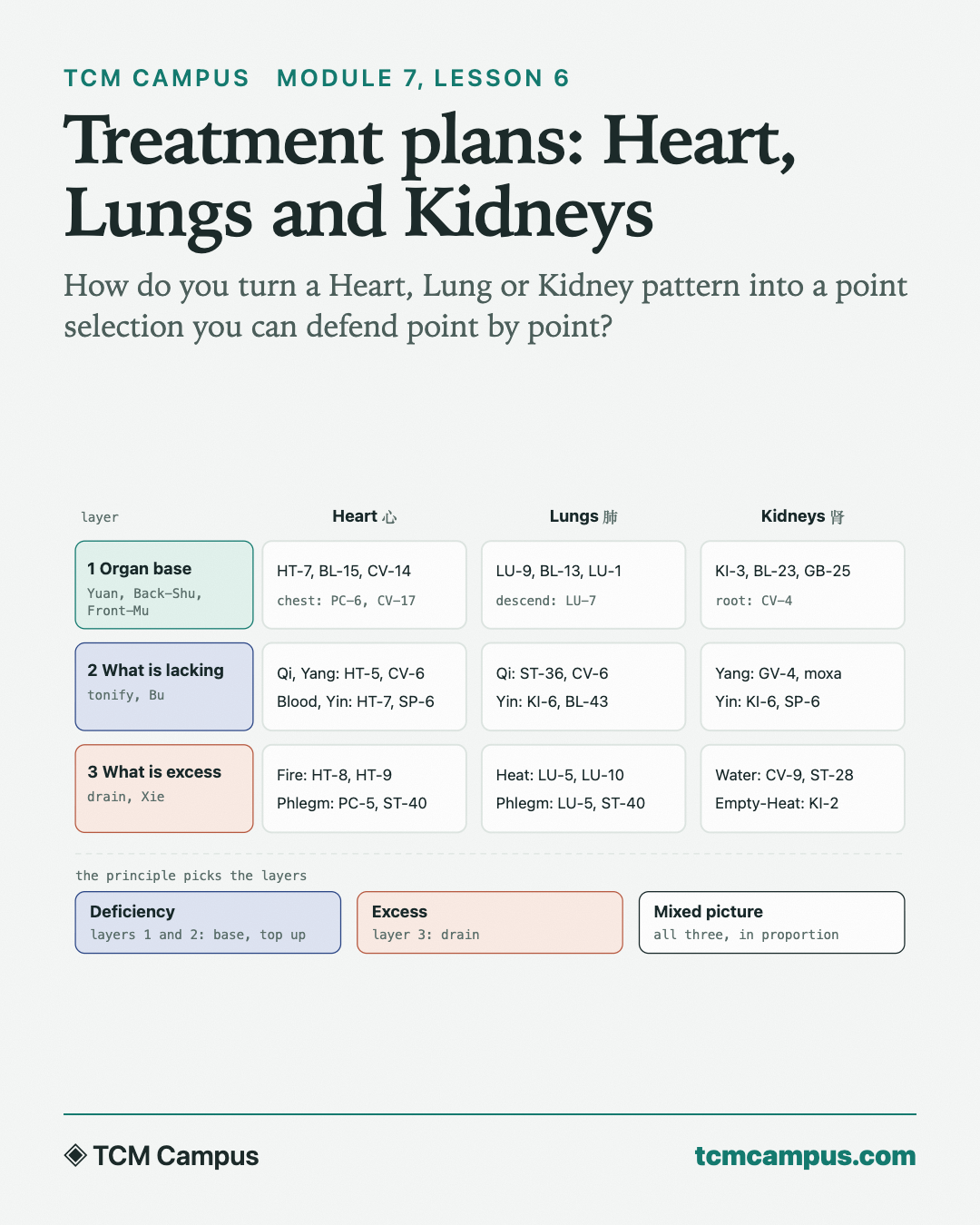
- Three layers. Organ base, what is lacking, what is in excess; the principle picks which layers take part. mnemonic: base, top up, drain.
- The organ base. Heart HT-7, BL-15, CV-14 (chest: PC-6, CV-17); Lungs LU-9, BL-13, LU-1 (LU-7 makes the Qi descend); Kidneys KI-3, BL-23, GB-25 (CV-4 as the root). mnemonic: Yuan on the hand or foot, Shu on the back, Mu on the front.
- Heart. Qi and Yang: HT-5, PC-6, BL-15, CV-17, CV-6, with moxa for Yang. Blood (13): HT-7, CV-14, BL-15, BL-20, SP-6, ST-36. Yin: HT-7, HT-6, KI-6, SP-6. Fire (15): HT-8, HT-7, CV-15, SP-6. Phlegm: PC-5, ST-40, CV-12. Stasis: PC-6, PC-4, CV-17, BL-17.
- Lungs. Qi (16): LU-9, LU-7, ST-36, BL-13, CV-6. Yin: LU-9, LU-7 with KI-6, BL-43. Heat and Phlegm-Heat: LU-5, LU-10, LU-1, LI-11, with ST-40 for Phlegm. mnemonic: LU-9 fills, LU-5 and LU-10 douse.
- Kidneys. Yang (12): BL-23, GV-4, KI-3, KI-7, CV-4 with moxa. Yin (11): KI-3, KI-6, SP-6, CV-4, without moxa; add KI-2 with Empty-Heat. Not receiving Qi: KI-3, KI-7, BL-23, CV-17, LU-7 with KI-6. Not firm: BL-23, KI-3, CV-4, CV-6.
- Two rules. Moxa in Yang deficiency and Cold, not in Empty-Heat. Ying-Spring clears Heat: HT-8, LU-10, KI-2. mnemonic: the spring douses the fire.
- Red flag. Chest pain, breathlessness at rest, coughing up blood, oedema with breathlessness, blood in the urine: see a doctor first.
The rest of this lesson is reference.
Three practice questions from this lesson
Which three points form the organ base of the Lungs?
- LU-5, LU-10, LI-11
- LU-9, BL-13, LU-1
- LU-7, LI-4, BL-12
Answer: LU-9, BL-13, LU-1. Yuan, Back-Shu and Front-Mu. LU-7, LI-4 and BL-12 are the Exterior (Wind, lesson 8); LU-5, LU-10 and LI-11 clear Heat.
The Front-Mu point of the Kidneys is ...
- BL-23
- KI-3
- GB-25
- CV-4
Answer: GB-25. GB-25. BL-23 is the Back-Shu point, KI-3 the Yuan point; CV-4 is the Front-Mu point of the Small Intestine and is used here as the root.
Why is HT-8 in the point selection for Heart-Fire?
- It is the Yuan point and nourishes Heart-Blood
- It is the Ying-Spring point and clears Heat
- It is the Xi-Cleft point and nourishes Heart-Yin
Answer: It is the Ying-Spring point and clears Heat. Ying-Spring points clear Heat (textbook knowledge, after Nan Jing 68). HT-8, LU-10 and KI-2 are the Ying-Spring points of this lesson. HT-6 is the Xi-Cleft point, HT-7 the Yuan point; they nourish and calm.
The rest of this lesson
In the course you get the step-by-step explanation, 17 case-based practice questions, 22 spaced-repetition flashcards, the pitfalls and the bridge to physiology with evidence grades. This lesson belongs to module 7: Treatment.