All lessons Module 1: Foundations Lesson 3
The vital substances and their pathology
What does an acupuncturist mean by "your Qi is stagnating" or "your Blood is deficient"?
After this lesson you can name the five substances from rarefied to dense, explain how Qi is formed and what it does, recognise the four ways in which Qi falls ill, and see how Qi and Blood sustain each other. These are the building blocks of every pattern in this course.
Know by heart
- Five substances, from rarefied to dense. Shen, Qi, Blood (Xue), Body Fluids (Jin-Ye), Jing (Essence); mnemonic: Shen thinks, Qi works, Blood nourishes, Fluids moisten, Jing stores.
- How Qi is formed. The Spleen makes Food Qi from food, the Lungs add air: together they form Zong Qi in the chest. With the spark of Yuan Qi from the Kidneys this becomes Zhen Qi, which splits into Ying Qi (nutritive, in the vessels) and Wei Qi (defensive, outside them); mnemonic: plate and breath, chest, spark, inside and outside.
- Six functions of Qi. transforming, transporting, holding, raising, protecting, warming; mnemonic: two Ts, two holders, two guards.
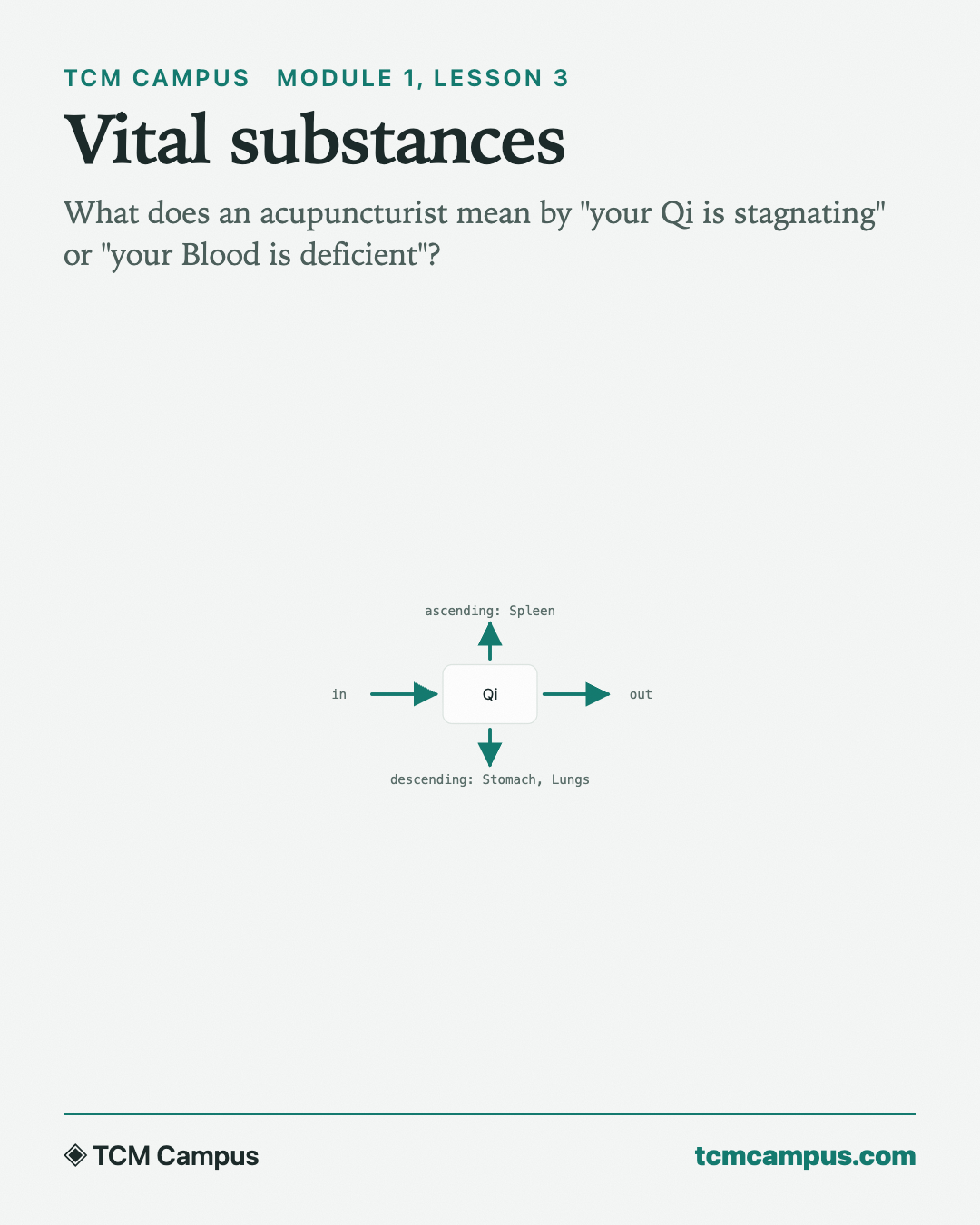
- Four directions, four faults. Qi ascends, descends, enters and exits; Spleen and Liver send it up, Stomach and Lungs send it down. Qi falls ill through deficiency, stagnation, sinking and rebellion; mnemonic: too little, stands still, sinks, goes the wrong way.
- Blood and Qi. Blood nourishes, moistens and anchors the Shen; it falls ill as deficiency, stasis or Heat. Qi makes, moves and holds the Blood (the commander); Blood nourishes and carries the Qi (the mother).
- Fluids and Jing. Jin is thin and quick (outside), Ye is thick and slow (inside); they fall ill as Dryness, oedema, Dampness or Phlegm. Jing is Pre-Heaven (constitution) and Post-Heaven (nourishment) and steers growth and reproduction in cycles of seven (women) and eight years (men); it falls ill as deficiency.
- Shen. Resides in the Heart, rests in the Blood: clear thinking, sound sleep, a sparkle in the eyes; it falls ill as restless, clouded or weak; mnemonic: 神 shén rises (the Mind), 腎 shèn falls (the Kidneys).
The rest of this lesson is reference.
Three practice questions from this lesson
Distension of the flank and abdomen that changes with the emotions; frequent sighing
- Qi deficiency
- Qi stagnation
- Blood stasis
Answer: Qi stagnation. Distension that moves with the emotions is Qi that is stuck: Liver-Qi stagnation (pattern 1). Blood stasis gives a fixed, stabbing pain.
Tired, weak voice, short of breath on exertion, spontaneous sweating
- Qi deficiency
- Rebellious Qi
- Jing deficiency
Answer: Qi deficiency. Too little Qi, and Wei Qi that does not hold the sweat in: Lung- and Wei-Qi deficiency (pattern 16).
Bearing-down sensation, haemorrhoids, prolapse
- Spleen deficiency with Dampness
- Qi stagnation
- Sinking Qi
Answer: Sinking Qi. The raising function of Spleen-Qi fails: sinking. Dampness makes you heavy and sticky, but does not drag downwards.
The rest of this lesson
In the course you get the step-by-step explanation, 22 case-based practice questions, 25 spaced-repetition flashcards, the pitfalls and the bridge to physiology with evidence grades. This lesson belongs to module 1: Foundations.